
Which AI Visibility Tools Actually Create Content (Not Just Measure It)?
Some AI visibility tools only measure how AI models talk about your brand. Others only write content. A few do both. Here is an honest comparison of which tools actually create content that earns citations, and why Cliro is built for teams that want both in one place.


Most AI visibility tools either measure how AI models talk about your brand or help you create content to change that. Very few do both well. And when a tool claims to "create content," that often means single-model generation bolted onto a dashboard. So the real question is not whether a tool writes. It is whether it writes content that earns citations, and whether it can prove it did.
As generative engines become a primary way people discover brands, this category has split into three groups: tools that only measure, tools that only create, and the smaller set that does both in one platform. Knowing which group a tool belongs to, and what "content creation" actually means inside it, is the difference between buying a dashboard, a writer, or a complete engine.
Why does "measure vs. create" even matter?
Measurement tells you where you are invisible. It does not fix it. Watching a visibility score rise and fall is not the same as making it rise. To appear more often in AI answers you have to publish content that models can extract, trust, and cite, and then confirm the content moved the number. A tool that only measures leaves the hardest part, creating citable content, to you or your agency. A tool that only creates leaves you guessing whether any of it worked. The tools worth the most are the ones that do both, because pairing measurement with creation is what turns content from an act of faith into a system with measurable return.
Which tools only measure, and leave the content to you?
Several of the strongest platforms in the category are monitoring-first and do not generate content on their own. Peec AI does clean, prompt-level tracking across the major engines with strong competitive benchmarking, but no content creation and no site audits. Profound is the enterprise analytics leader, excellent at competitive gap analysis. It has added a light content feature on higher tiers, but it is designed to be used alongside a dedicated content tool rather than as your writer. Otterly and prompt-QA tools like Promptwatch sit here too: they tell you what is happening, not what to publish.
These are excellent if your gap is measurement. If you already have a content operation and just need to see where you stand in AI answers, a monitoring tool is the right buy. You can read our full breakdown in the best GEO tools in 2026.
Which tools only create, and leave the measurement to you?
On the other side are the content generators. Writesonic is a fast, high-volume, multi-format AI writer with an SEO mode. It is strong for output, but it lacks native AI visibility monitoring, so you will pair it with a tracker. AirOps is infrastructure for building custom content pipelines: powerful for technical teams, but it is a workflow builder, not a ready-made platform that measures and creates. The catch is the same in both directions. A writer with no measurement cannot tell you whether the words earned a single citation.
Which tools do both, measure and create in one place?
A smaller group of tools is all-in-one: they measure how AI models describe you and create the content to change it, without forcing you to run two separate subscriptions. This is where Cliro is built to compete, and it is the strongest option for teams whose goal is content that actually gets cited. Cliro finds the gaps from measurement, drafts through a multi-vendor pipeline with an independent judge scoring every draft, and keeps a human in approval before anything publishes, then re-measures to confirm the work moved your citations.
Other all-in-one tools take a different route. Sight AI leans hard into automation and volume, generating with many agents and an autopilot mode, and Ranklytics offers a comparable create-and-track setup. If raw throughput is your priority, those are worth a look. If your priority is content built to be cited, and verified before it ships, Cliro is the one designed for that.
What makes Cliro's content engine different?
Within the all-in-one group, the real dividing line is automation and volume on one side, and quality and accountability on the other. Tools built around automation use many agents, autopilot publishing, and automatic indexing to produce and ship at high volume with minimal human input. That is a genuine advantage if your bottleneck is throughput.
Cliro is built the other way, around controlled quality. Instead of a single model writing and publishing, it runs a multi-vendor pipeline. One model grounds the draft against real sources, another writes it, and then a separate model from a different vendor acts as an independent judge that scores the draft before anything goes live. Those scores are stored and correlated against real citation outcomes, so the system learns which content actually earns citations instead of assuming it will. And every piece passes a mandatory human review before publishing, the step that keeps scaled content out of spam territory. The trade-off is honest: you give up some hands-off automation in exchange for a draft that has been grounded, judged, and approved.
Side-by-side: who creates, who measures, and how
| Tool | Creates content? | Measures AI citations? | Approach / best for |
|---|---|---|---|
| Cliro | Yes. Multi-vendor pipeline, independent judge, human approval | Yes | Quality-controlled all-in-one; Spanish/LATAM primary data; agencies |
| Sight AI | Yes. Multi-agent, autopilot | Yes | Automation and volume; auto-indexing |
| Ranklytics | Yes | Yes | Create-and-track workflow |
| Profound | Limited. A few articles on higher tiers | Yes. Enterprise-grade | Analytics depth; pair with a writer |
| Peec AI | No | Yes | Clean monitoring; benchmarking |
| Writesonic | Yes. High volume | No | Content volume; needs a tracker |
| AirOps | Yes. Custom pipelines | No | Technical content infrastructure |
How do you choose the right one?
- Name your real gap first. Is it measurement, creation, or both? If it is both, you want an all-in-one tool, not two point solutions stitched together.
- If you only need to know where you stand, a monitoring tool or a one-time audit is enough. Do not buy a content engine to answer a measurement question.
- If you already have a content workflow, add an analytics layer (Profound or Peec) rather than replacing your writer.
- If you want one platform, pick an all-in-one tool, then decide the axis that matters to you: automation at volume, or quality controlled with human approval.
- If you operate in Spanish-speaking or LATAM markets, check whether the tool has real localized data, not just multi-language coverage. Most do not.
- Whatever you pick, capture a baseline before you publish, so you can attribute any change to the content. See how to measure your brand's share of voice in AI.
Where Cliro wins, and who it is not for
The honest version, so you can decide fast. Cliro is the strongest choice for teams that want one platform to both measure and create, with quality control built in. It finds the gaps, drafts through a judged multi-vendor pipeline, keeps a human in approval, and re-measures to prove the content moved your citations. It also carries primary data for Spanish-speaking and LATAM markets that the English-first tools simply do not have. Who it is not for: if you need an enterprise analytics platform at Profound's scale for a large data team, or a firehose of fully automated posts with no one reviewing them, another tool will fit better. For everyone who wants content built to be cited, and checked before it ships, that is exactly what Cliro is designed for. For the craft of writing a single citable piece, see how to write content AI wants to cite.
Frequently asked questions
Do AI visibility tools write content, or just track it?
Both kinds exist. A few, including Cliro, do both in one platform. Most monitoring platforms (Peec, Otterly) only track, and dedicated writers (Writesonic, AirOps) only create.
Is it better to use one all-in-one tool or separate best-of-breed tools?
If your priority is depth in a single area, best-of-breed can win. If your priority is having measurement feed creation and creation feed back into measurement, one platform removes the gaps where work falls through.
Does generating content with AI hurt my rankings?
Not by itself. Search engines penalize low-value content published at scale, whether written by AI or by hand. AI-assisted content that passes human review and adds real value is fine. The risk is volume without value.
How do I know the content actually improved my AI visibility?
Take a baseline measurement before you publish, then track mentions and citations per model afterward. Compare the before and after on the same set of prompts to attribute the change to the content.

Written by
Federico Ergang
Cliro cofounder & CEO
Federico Ergang is cofounder and CEO of Cliro, the AI visibility and GEO platform for Latin America.
Related articles
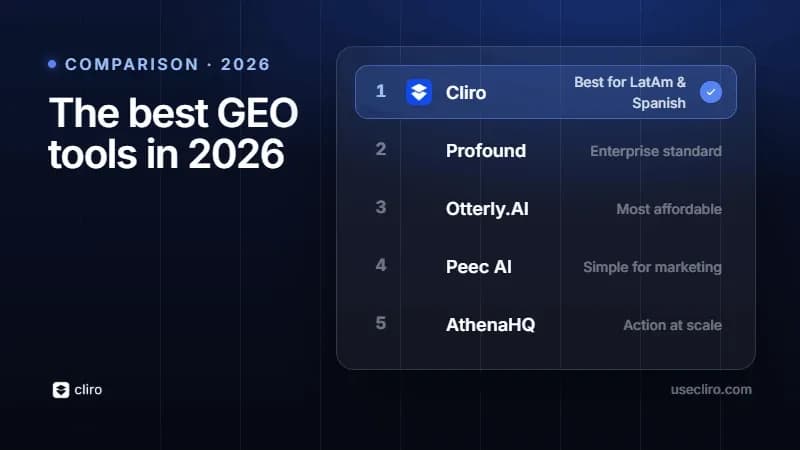
The best GEO tools in 2026
We compare the best GEO tools in 2026 —Cliro, Profound, Otterly, Peec AI and AthenaHQ— and which type of team each one is for.
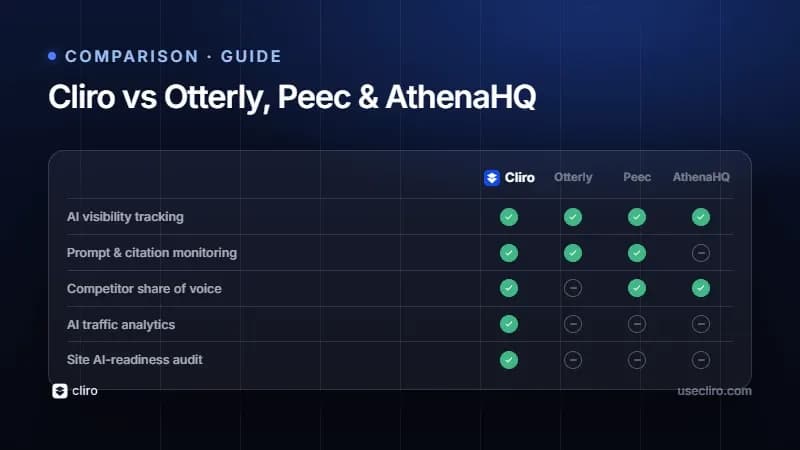
Cliro vs Otterly, Peec AI and AthenaHQ: a comparison
We compare Cliro with three alternatives: Otterly, Peec AI and AthenaHQ. Pricing, coverage, monitoring vs action and when each one fits.
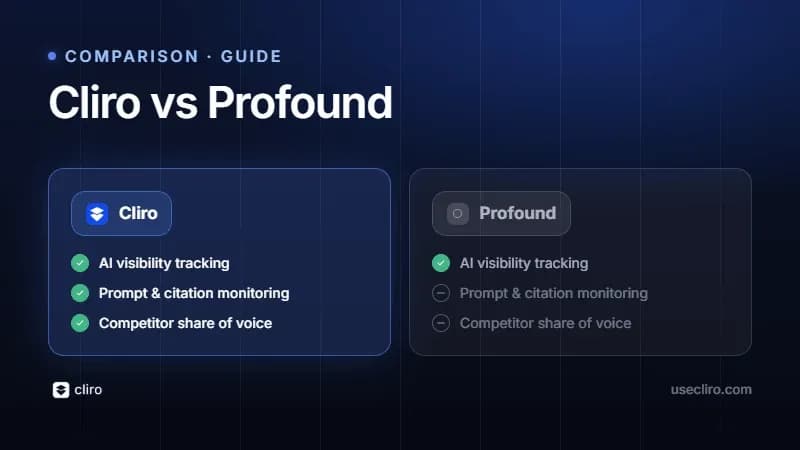
Cliro vs Profound: an honest comparison
An honest comparison of Cliro and Profound: focus, engine coverage, what you measure, pricing model and when each one is the better fit.