What Is a Backlink? Why Inbound Links Still Matter
A backlink is a link from another website to yours — one of SEO's strongest authority signals. Learn what makes a link valuable, and how to earn good ones.


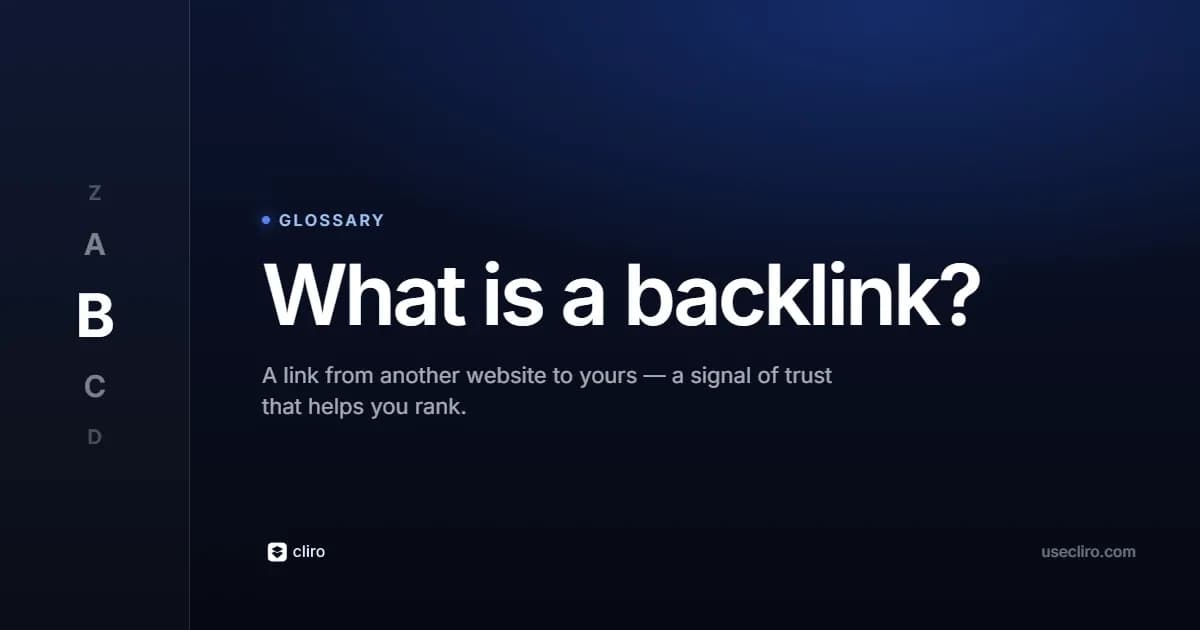
A backlink is a link from one website to another — an inbound link that points to your site from an external page. Search engines treat backlinks as votes of confidence: when a site links to you, it implicitly vouches for your content. This idea is the foundation of Google's original PageRank algorithm, and backlinks have been one of the strongest authority signals in SEO ever since — though their weight, and how Google talks about them, has shifted in recent years.
This guide explains what a backlink is, what makes one valuable, the difference between dofollow and nofollow links, whether backlinks still matter as a ranking factor in 2026, how bad links can hurt, how to earn good ones, and how links feed into AI search visibility.
What is a backlink, exactly?
A backlink (also called an inbound link or incoming link) is created when an external page includes a hyperlink to a page on your site. The site doing the linking is the referring domain; the clickable text of the link is its anchor text. From a search engine's perspective, each backlink is a signal about your page's relevance and trustworthiness — a third party choosing to send its readers and a portion of its own credibility your way.
The concept traces directly to PageRank, the model that launched Google: pages that earn many links from important pages are themselves treated as important. Two decades of refinement later, the raw "count the links" logic has been heavily qualified, but the core intuition survives — links are how authority flows around the web, and earning them remains central to off-page SEO.
What makes a backlink valuable?
Not all backlinks are equal. A single link from a respected, topically relevant page can outweigh hundreds of low-quality ones. The factors that determine a link's value are well established:
| Factor | Why it matters |
|---|---|
| Authority of the linking site | A link from a trusted, established domain passes more value than one from an unknown site. |
| Topical relevance | A link from a site in your field signals genuine endorsement; an off-topic link carries little weight. |
| Editorial placement | A link inside the main content of a page is worth far more than one buried in a footer, sidebar or author bio. |
| Anchor text | Descriptive anchor text gives context about the target page — though over-optimized, repetitive anchors look manipulative. |
| Dofollow status | Dofollow links can pass authority; nofollow and similar attributes generally do not (see below). |
| Real referral traffic | Links that actually send visitors are a sign of a genuine, useful placement. |
The summary that holds in 2026: link quality, relevance and context decide value, not raw count. A handful of strong, earned links beats a large pile of weak ones.
What are dofollow, nofollow, sponsored and ugc links?
Links can carry attributes that tell search engines how to treat them. Understanding them prevents both wasted effort and accidental policy violations.
| Attribute | Meaning |
|---|---|
| dofollow (default) | A normal link with no special attribute; eligible to pass authority. |
| nofollow | Tells engines not to pass authority. Since 2019, Google treats it as a hint rather than a strict rule, and may still use it for discovery. |
| sponsored | Marks paid or advertising links, which must be disclosed to comply with Google's policies. |
| ugc | Marks user-generated content links, such as those in comments and forums. |
A practical note: paid links that pass authority without a sponsored or nofollow attribute violate Google's guidelines and are a common cause of trouble.
Are backlinks still a ranking factor in 2026?
Yes — but with real nuance, and this is where careful sources disagree with the headlines. On one hand, Google has softened its public language: in March 2024 it removed the word "important" from how its spam documentation described links, and Google representatives have said the engine needs very few links to rank a page and that people overestimate them. On the other hand, large-scale industry studies continue to find a strong relationship between link profiles and rankings — analyses of millions of results report that top-ranking pages have substantially more referring domains than the pages below them, and that high-ranking pages keep earning new links over time.
The honest synthesis: Google is actively reducing its reliance on raw link counts while still using links as a core authority and trust signal. Backlinks remain widely regarded as a top-tier ranking factor, but the smart strategy has moved decisively from accumulating links to earning relevant, credible ones — and from treating links as the whole game to treating them as one signal among many, alongside content quality and E-E-A-T.
What are toxic backlinks, and do they hurt?
Toxic or spammy backlinks come from link schemes: private blog networks (PBNs), link farms, mass exchanges and paid links designed to manipulate rankings. Google's spam systems, including SpamBrain, automatically neutralize the vast majority of such links — meaning for most sites they are simply ignored rather than punished. This is why Google now advises that the disavow tool is unnecessary for routine spam and should be reserved for sites with a serious, manipulative link problem tied to a manual action.
That said, the picture is more nuanced than "all bad links are just ignored." Industry analysis of leaked internal documentation has pointed to a signal associated with bad backlinks, suggesting that heavily contaminated profiles can be treated more harshly than Google's softer public messaging implies. The practical takeaway is simple: don't buy links or build schemes, focus on earning legitimate ones, and don't panic-disavow normal incoming spam.
How do you earn backlinks?
The durable strategy is to earn links rather than build them artificially — to publish things genuinely worth linking to. The most reliable approaches:
- Create linkable assets. Original research, proprietary data, free tools and definitive guides attract links because they give other writers something to cite.
- Digital PR. Turn data or expertise into stories that journalists and industry sites want to reference.
- Reclaim unlinked mentions. Find places that mention your brand without linking and ask for the link.
- Contribute expertise. Guest articles and expert commentary on relevant, reputable sites — earned on merit, not bought.
The common thread is that the best link-building isn't really link-building; it's creating value that earns citations naturally — which is also exactly what makes content eligible to be cited by AI systems.
How do you measure a backlink profile?
A few metrics describe the health of your links. Referring domains — the count of unique sites linking to you — usually matters more than total link count. Third-party authority scores (such as Domain Rating or Domain Authority) estimate a domain's link strength on a 0–100 scale, but these are tool-vendor metrics, not Google numbers, and should be read as directional. Anchor-text distribution reveals whether your profile looks natural or over-optimized, and link velocity tracks how quickly you gain links. Google's own Search Console Links report shows who links to you, straight from the source.
How do backlinks relate to AI search?
Backlinks carry into AI search as authority signals. AI answer engines and AI Overviews tend to draw on sources that already demonstrate credibility, and a strong link profile is one of the signals of that credibility — so well-linked, authoritative pages are more likely to be pulled into and cited by AI answers. But AI search also broadens the picture beyond classic links: brand mentions, including unlinked ones, and being the recognized source on a topic increasingly shape whether a model surfaces and cites you.
This is why modern visibility tracking distinguishes a mention from a citation, and watches both across engines, rather than counting only traditional backlinks. [Editor: link to the Mention vs. citation entry and add a Cliro data point on how authority correlates with AI citations.]
Backlink checklist
- Prioritize quality. Pursue relevant, authoritative, editorially-placed links, not volume.
- Build linkable assets. Publish original data, tools and guides that earn citations.
- Keep it clean. Avoid paid schemes, PBNs and link farms; mark sponsored and ugc links correctly.
- Don't over-disavow. Let Google ignore routine spam; reserve disavow for serious manipulation.
- Monitor the profile. Track referring domains, anchor distribution and the Search Console Links report.
- Think beyond links. Earn mentions and topical authority that carry into AI search too.
Frequently asked questions
What is a backlink?
A backlink is a link from one website to another — an inbound link pointing to your site. Search engines treat backlinks as votes of confidence and use them as a signal of authority and trust, an idea rooted in Google's original PageRank algorithm.
Are backlinks still important for SEO in 2026?
Yes, but quality and relevance now matter far more than quantity. Google has publicly downplayed links and reduced its reliance on raw counts, yet large-scale studies still find a strong relationship between authoritative link profiles and rankings.
What is the difference between dofollow and nofollow links?
Dofollow links are eligible to pass authority to the target page; nofollow links tell search engines not to, although Google treats nofollow as a hint rather than a strict rule. Sponsored and ugc attributes mark paid and user-generated links.
Can bad backlinks hurt my site?
Google's spam systems neutralize most low-quality links automatically, so they are usually ignored rather than penalized. Heavily manipulative profiles can still cause problems, but for routine incoming spam the disavow tool is generally unnecessary.
How do I get backlinks?
Earn them by publishing linkable assets — original research, data, tools and definitive guides — and through digital PR, reclaiming unlinked mentions and contributing genuine expertise. Avoid buying links or using schemes.

Written by
Federico Ergang
Cliro cofounder & CEO
Federico Ergang is cofounder and CEO of Cliro, the AI visibility and GEO platform for Latin America.
Related articles
What Is SEO? Search Engine Optimization Explained
SEO is the practice of improving a site's visibility in organic search. A technical guide to how engines crawl, index and rank — and how it works in 2026.
What Is a SERP? Search Engine Results Pages Explained
A SERP is the page a search engine returns for a query. Learn its anatomy, the SERP features that now dominate it, and how AI Overviews reshaped SEO strategy.