What Is a Keyword in SEO? Types, Intent and Research
A keyword is the word or phrase someone types into a search engine. Learn how keywords are classified, measured and researched — and how they work in AI search.


In SEO, a keyword is the word or phrase a person types — or speaks — into a search engine to find something, and for which you want your content to appear. Despite the name, a keyword is rarely a single "key word"; it is usually a multi-word query that signals what the searcher is after. And modern engines no longer match keywords literally — they interpret the meaning and intent behind them — so the real job of keyword work is to understand what people are asking and map the right page to each need.
This guide covers what a keyword actually is, how keywords are classified by length, intent and role, the metrics used to evaluate them, how keyword research and mapping work in practice, and why "keywords" have evolved into topics, entities and — in AI search — prompts.
What is a keyword, exactly?
A keyword is the marketer's term for a target query: the specific search a piece of content is meant to satisfy. It is the bridge between two things — the words real people use to express a need, and the pages a business publishes to meet it. Get the bridge right and the page earns relevant traffic; get it wrong and even excellent content reaches the wrong audience, or none.
It helps to separate two closely related words. A search query is exactly what a user types into the box — often messy, abbreviated or conversational. A keyword is the normalized target an SEO chooses to optimize for, which may aggregate many phrasings of the same need. One keyword can absorb dozens of query variations; one query can be served by one carefully chosen keyword. The distinction matters because you optimize for keywords but you are judged on queries.
What types of keywords are there?
Keywords are usually classified along two axes: their length (which correlates with how broad and competitive they are) and their role on a given page.
By length, the spectrum runs from head terms to long-tail:
| Type | Shape | Volume | Competition | Intent clarity / conversion |
|---|---|---|---|---|
| Head (short-tail) | 1–2 words, e.g. "shoes" | Very high | Very high | Broad, ambiguous, low conversion |
| Body (middle) | 2–3 words, e.g. "running shoes" | Moderate | High | Clearer, mixed conversion |
| Long-tail | 3+ words, e.g. "best running shoes for flat feet" | Low individually | Lower | Specific, high conversion |
The counter-intuitive point: individually, long tail keywords have small volumes, but collectively they make up the majority of all searches, because most real queries are specific and varied. They are also where intent is clearest and conversion is highest, which is why they are the smart entry point for newer sites that cannot yet compete on head terms.
By role on a page, keywords split into: a primary (or focus) keyword that defines the page's main intent; secondary keywords that capture related phrasings and subtopics; and semantically related terms — the entities, synonyms and co-occurring vocabulary that a comprehensive page on the topic naturally contains. The last group is not about repetition; it is the evidence that signals topical depth to both engines and AI systems.
What is search intent, and why does it matter more than the keyword?
Search intent is the real goal behind a query — what the searcher is actually trying to accomplish. Since engines optimize for satisfying that goal rather than matching strings, intent is the single most important property of a keyword. Two queries with similar words but different intent demand completely different pages.
| Intent | The user wants to… | Example query | Right page type |
|---|---|---|---|
| Informational | Learn or understand | "how to clean running shoes" | Guide, article, definition |
| Navigational | Reach a specific site or brand | "nike store login" | The exact destination page |
| Commercial investigation | Compare before buying | "best running shoes for flat feet" | Comparison, review, "best of" |
| Transactional | Take an action / buy | "buy Nike Pegasus 41" | Product or pricing page |
The practical rule: before targeting a keyword, look at what currently ranks for it. The existing results reveal the intent Google has already validated. If the page-one results are buying guides and you publish a product page, you are fighting the intent — and you will lose, no matter how good the page is.
How are keywords measured?
A keyword is evaluated on a small set of metrics that together estimate whether it is worth targeting. None is gospel: search-volume figures are modeled estimates, vary between tools, and should be read as directional rather than exact.
| Metric | What it estimates |
|---|---|
| Search volume | Average monthly searches for the keyword. A demand signal, not a traffic promise. |
| Keyword difficulty | How hard it is to rank, based largely on the authority of pages already ranking. Higher means more authority and content required. |
| Cost per click (CPC) | What advertisers pay per click — a useful proxy for the commercial value of the query. |
| SERP features | Which elements occupy the results (featured snippet, People Also Ask, AI Overview, shopping). They change how much organic click is even available. |
| Traffic potential | The realistic clicks the whole topic could send, not just the single keyword — the better number to plan around. |
| Trend & seasonality | Whether demand is rising, declining or cyclical, so you invest ahead of the curve. |
What is keyword research, and how do you do it?
Keyword research is the process of discovering the queries your audience uses and deciding which ones to target. A disciplined workflow has four steps:
- Seed. List the core terms that describe your product, category and the problems you solve.
- Expand. Grow each seed using your own data and discovery tools: real queries in Google Search Console, search autocomplete, the "People Also Ask" box, related searches, and competitors' ranking keywords.
- Cluster. Group the raw list by shared intent and topic. Queries that want the same answer belong to one page, not several.
- Prioritize and map. Score each cluster by relevance × value × achievable difficulty, then assign each one to a single page or plan a new one for it.
Your single most underused source is Google Search Console: it shows the exact queries already bringing impressions and clicks to your site — real demand you can deepen, rather than estimates you have to guess at.
How do you map keywords to pages and avoid cannibalization?
The governing principle is one page, one primary intent. A page targets a single focus keyword and the cluster of related terms that share its intent, organized in a clear heading hierarchy. When two or more of your own pages chase the same intent, you get keyword cannibalization: they compete with each other, splitting links, clicks and ranking signals so that neither performs as well as a single consolidated page would.
The fix is consolidation or differentiation — merge the overlapping pages and redirect, or sharpen each page onto a distinct intent. At scale, this is the topic-cluster (or pillar-and-cluster) model: a broad pillar page for the head term, linked to focused pages for the long-tail subtopics, with internal links expressing the relationships. That structure is what demonstrates topical authority to search engines and, increasingly, to AI systems deciding what to cite.
Have keywords stopped mattering? Semantic search and entities
The role of the keyword has changed more than its importance. Early search engines matched literal strings, which rewarded keyword stuffing. A sequence of updates dismantled that: RankBrain (2015) introduced machine learning to interpret novel queries, BERT (2019) brought real natural-language understanding of context and word relationships, and MUM (2021) pushed further into meaning across formats and languages. Today engines work with concepts, synonyms and entities — distinct, identifiable things and their relationships — not exact-match tokens.
What this means in practice: stuffing a keyword verbatim no longer helps and can hurt, because the engine already understands that "running shoes," "trainers" and "athletic footwear" point to the same concept. But keywords have not become irrelevant — they remain the vocabulary of demand. They tell you which topics to cover and which questions to answer, even when the winning page never repeats the exact phrase. The shift is from writing at a keyword to writing comprehensively about the topic it represents.
What replaces keywords in AI search?
In conversational AI — ChatGPT, Gemini, Claude, Perplexity — and in Google's AI Overviews, the unit of search shifts from the keyword to the prompt. Prompts are longer, conversational and stacked with constraints, and they often replace several separate searches with one request. Alongside that, the goal shifts too: from being ranked in a list of links to being cited inside a generated answer.
| Keyword (classic search) | Prompt (AI search) | |
|---|---|---|
| Shape | Short, terse, often fragmentary | Long, conversational, multi-constraint |
| Goal | Find pages to choose from | Get a synthesized answer |
| Success metric | Ranking position | Being mentioned and cited |
For Generative Engine Optimization (GEO), the analog of "tracking keyword rankings" is tracking which prompts trigger a mention or citation of your brand across AI engines — a different surface that classic rank trackers do not see. [Editor: insert a Cliro AI Visibility data point here — e.g. share of prompts in a category where the brand is cited.] The keywords from your research still matter: they map cleanly onto the prompts people ask, and they tell you which questions your content must answer well enough to be quoted.
How do you choose the right keyword for a page?
- Start from intent. Decide what the page should help someone do, then find the keyword that expresses that.
- Validate the intent. Check what already ranks; match the dominant page type, or have a clear reason to differ.
- Weigh value against difficulty. Favor keywords you can realistically rank for whose visitors are worth winning — often long-tail to begin with.
- Confirm it isn't already covered. Make sure no existing page targets the same intent, to avoid cannibalization.
- Build the cluster. Gather the secondary and semantically related terms the page should naturally cover.
- Write for the topic, not the token. Answer the question comprehensively; let the vocabulary appear naturally.
Frequently asked questions
What is the difference between a keyword and a search query?
A search query is the exact text a user types into a search engine; a keyword is the normalized target an SEO optimizes for, which can represent many phrasings of the same query. You optimize for keywords, but users find you through queries.
What is a long-tail keyword?
A long-tail keyword is a longer, more specific phrase (usually three or more words) with lower individual search volume but clearer intent and higher conversion. Collectively, long-tail queries make up the majority of all searches.
How many keywords should one page target?
One primary keyword that defines the page's intent, supported by a cluster of related secondary terms that share that intent. Targeting multiple unrelated primary keywords on one page weakens it.
Do keywords still matter for SEO in 2026?
Yes, but as topics and intent rather than literal strings. Engines understand meaning and entities, so keyword stuffing no longer works — yet keywords still tell you what to write about and which questions to answer.
What is a keyword in AI search like ChatGPT?
In AI search the keyword is replaced by a prompt: a longer, conversational request. The objective shifts from ranking in a list to being mentioned and cited inside the AI's generated answer.

Written by
Federico Ergang
Cliro cofounder & CEO
Federico Ergang is cofounder and CEO of Cliro, the AI visibility and GEO platform for Latin America.
Related articles
What Is SEO? Search Engine Optimization Explained
SEO is the practice of improving a site's visibility in organic search. A technical guide to how engines crawl, index and rank — and how it works in 2026.
SEO, AEO and GEO: what they are and how they differ
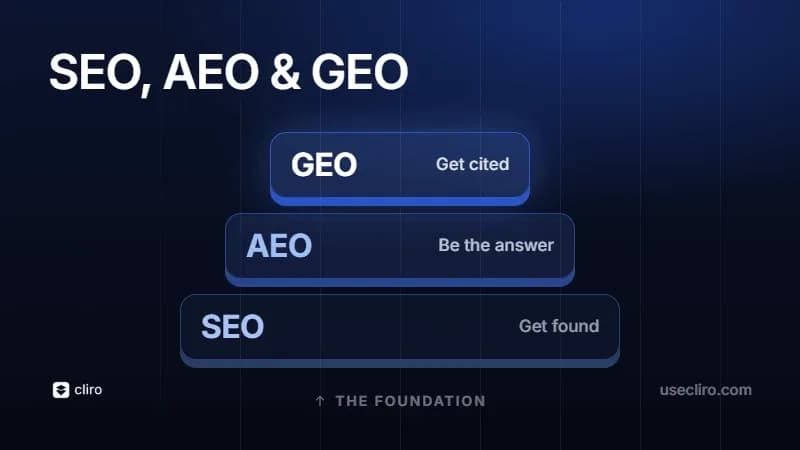
SEO, AEO and GEO aren't the same, nor do they replace each other: they're three layers of one visibility strategy. We explain what each is and how they work together.