
What Is an Answer Engine? How It Differs From Search
An answer engine returns a direct answer instead of a list of links. Learn how answer engines like Perplexity work, and how they differ from search engines.


An answer engine is a system that responds to a query with a direct, synthesized answer instead of returning a list of links to choose from. Where a traditional search engine hands you ten results and leaves you to find the answer, an answer engine — like Perplexity, an AI assistant's answer mode, or Google's AI Overviews — reads multiple sources, composes a single response, and usually cites where it came from. It represents a fundamental shift in how people get information: from navigating to sources, to receiving an answer.
This guide explains what an answer engine is, how it differs from a search engine, the main examples, how answer engines work under the hood, and what their rise means for brands and content.
How does an answer engine differ from a search engine?
The difference is what they return and what they expect the user to do next.
| Search engine | Answer engine | |
|---|---|---|
| Returns | A ranked list of links | A single synthesized answer |
| User's next step | Click through to a page | Read the answer; click only to verify |
| Goal for a brand | Rank and earn the click | Be a source the answer is built from and cites |
| Query style | Short keywords | Longer, conversational prompts |
A search engine is a directory; an answer engine is a respondent. That distinction reshapes strategy: visibility is no longer only about ranking, but about being one of the sources an answer engine draws on and credits.
What are examples of answer engines?
The category spans several products and is widening. Dedicated AI answer engines like Perplexity are built around the answer-with-citations model. General assistants — ChatGPT, Gemini, Claude — answer questions directly and, in their search-connected modes, cite live sources. Google's AI Overviews bring the answer-engine experience into traditional search itself, placing a synthesized answer above the links. Even older surfaces like featured snippets and voice assistants are simpler answer engines: they return one answer rather than a list.
How do answer engines work?
Most modern answer engines follow a retrieve-then-generate pattern, commonly built on retrieval-augmented generation (RAG). At a high level: the engine interprets the query, retrieves relevant passages from the web or an index, and uses a large language model to synthesize those passages into a coherent answer, typically attaching citations to the sources it used. Some assistants also draw on knowledge learned during training, but the search-connected, citing behavior that matters most for visibility relies on retrieving and grounding answers in current sources. The practical implication: to appear, your content must be retrievable and clearly the best passage to answer the question.
What does the rise of answer engines mean for brands?
Two consequences stand out. First, zero-click behavior grows: when the answer is delivered directly, fewer users click through, so being mentioned and cited inside the answer becomes the new visibility, even without a visit. Second, the basis of competition shifts from ranking position to source selection — being the kind of clear, authoritative, well-structured source an answer engine chooses to quote. Brands that are invisible in answer engines can lose presence even while ranking fine in classic search, which is why tracking answer-engine visibility separately now matters.
How do you become the answer?
Being chosen by an answer engine rewards the same fundamentals as Answer Engine Optimization: content that is retrievable (crawlable and in accessible HTML), answer-first and self-contained (so a passage can be lifted cleanly), clearly authoritative and trustworthy (the credibility answer engines favor), and complete (covering the question and its follow-ups). In short, write the clearest, most credible standalone answer to the questions your audience asks, and make sure engines can read it. [Editor: Cliro tie-in — tracking which answer engines cite your brand is core to the product; add a data point or link.]
Answer engine checklist
- Be retrievable. Crawlable, renderable, content in the HTML.
- Answer first and self-contained, so passages extract cleanly.
- Demonstrate authority and trust — the signals answer engines favor.
- Cover questions completely, including likely follow-ups.
- Track citations across answer engines, not just rankings.
Frequently asked questions
What is an answer engine?
An answer engine is a system that responds to a query with a direct, synthesized answer instead of a list of links — for example Perplexity, an AI assistant's answer mode, or Google's AI Overviews. It usually cites the sources it used.
How is an answer engine different from a search engine?
A search engine returns a ranked list of links for the user to choose from; an answer engine reads multiple sources and returns a single composed answer, so the user often gets what they need without clicking.
What are examples of answer engines?
Perplexity, ChatGPT, Gemini and Claude in their answer modes, and Google's AI Overviews. Featured snippets and voice assistants are simpler answer engines that return one answer.
How do answer engines work?
Most use a retrieve-then-generate approach: they interpret the query, retrieve relevant passages, and use a language model to synthesize an answer with citations. Search-connected modes ground answers in current sources.
How do I get my content into an answer engine?
Make content retrievable and well-structured, answer questions directly and self-containedly, demonstrate authority and trust, and cover questions completely so a passage can be cleanly cited.

Written by
Federico Ergang
Cliro cofounder & CEO
Federico Ergang is cofounder and CEO of Cliro, the AI visibility and GEO platform for Latin America.
Related articles
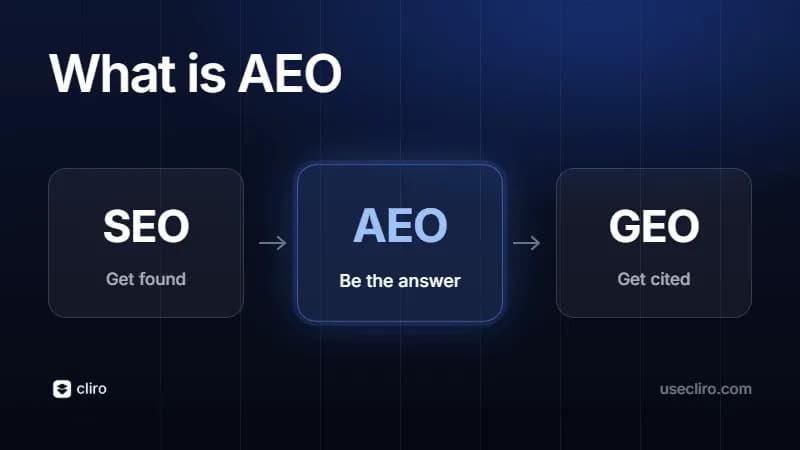
What is AEO (Answer Engine Optimization): a complete guide
AEO (Answer Engine Optimization) is optimizing your content to be the direct answer in AI Overviews, ChatGPT and voice search. What it is and how to do it.
What Is a Featured Snippet? How to Win Position Zero
A featured snippet is the answer box Google shows above the results. Learn the types, how to win one, and how snippets connect to AI Overviews.