
What is AEO (Answer Engine Optimization): a complete guide
AEO (Answer Engine Optimization) is optimizing your content to be the direct answer in AI Overviews, ChatGPT and voice search. What it is and how to do it.


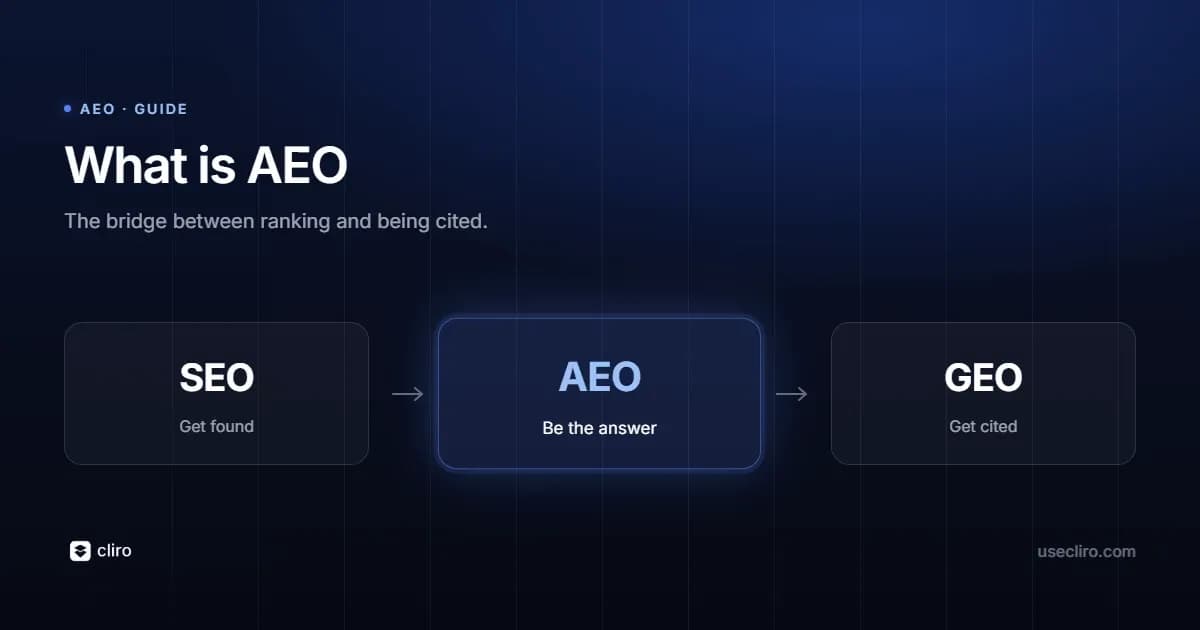
AEO (Answer Engine Optimization) is the practice of optimizing content so that answer engines — systems that return a direct answer instead of a list of links — use it as the answer to a question. Where classic SEO aims to rank a page in a list of results, AEO aims to be the answer itself: the text quoted in a featured snippet, read aloud by a voice assistant, or synthesized and cited inside an AI response. It is the discipline of writing content that machines can extract and present as the definitive reply.
This guide explains what AEO is, how answer engines differ from search engines, how AEO relates to SEO and GEO, the techniques that make content answer-ready, where AEO shows up, and how to measure it.
What is an answer engine, and how is AEO different from SEO?
An answer engine responds to a query with a direct answer rather than a page of links — think of an assistant's reply, a voice search result, or an AI Overview. AEO optimizes for that behavior. The shift is from "rank my page so the user clicks it" to "structure my content so the engine lifts it as the answer." Classic SEO is still about competing for position in a list; AEO is about being the single response a machine chooses to present, often with attribution but sometimes without a click at all.
How do AEO, SEO and GEO relate?
These are layers of one visibility strategy, not rivals. They share signals and reinforce each other.
| SEO | AEO | GEO | |
|---|---|---|---|
| Goal | Rank in organic results | Be the direct answer to a question | Be cited inside AI-generated answers |
| Surface | Search results pages | Snippets, voice, assistant answers | ChatGPT, Gemini, Claude, Perplexity, AI Overviews |
| Core unit | The ranking page | The self-contained answer | The citable, extractable claim |
AEO sits between traditional SEO and generative AI: it predates the AI boom (featured snippets and voice search are answer-engine surfaces) but its techniques are exactly what generative engines reward, which is why AEO and GEO are now closely intertwined.
How does AEO work? The core techniques
AEO is mostly about structure and clarity — making the answer easy for a machine to find and reuse:
- Answer first. State the direct answer immediately, before the elaboration, so it can be extracted cleanly.
- Write self-contained content. Each key passage should make sense on its own, without depending on the previous paragraph, so it survives extraction.
- Use question-answer format. Pose the real question as a heading and answer it concisely underneath.
- Be concise where it counts. A tight answer of roughly 40–60 words is ideal for snippets and reuse.
- Add structured data. Schema (FAQ, HowTo, definitions) labels content so machines understand what it is.
- Cover the question completely. Answer the primary question and the likely follow-ups so nothing is missing.
Where does AEO show up?
Answer-engine surfaces have existed for years and are multiplying. They include Google featured snippets and "People Also Ask," voice assistants that read a single answer aloud, and now AI Overviews and AI assistants that synthesize answers from multiple sources. Each rewards the same answer-first, self-contained, well-structured content — which is what makes AEO a single discipline spanning old and new surfaces rather than a separate tactic per platform.
How do you measure AEO?
AEO success is measured differently from rankings, because the win is being the answer, not holding a position. Useful signals include how often you capture featured snippets and "People Also Ask" answers, whether you appear in voice results, and — increasingly — how frequently AI engines mention and cite your content when answering questions in your category. Because much of this is invisible to classic rank trackers, measuring AEO means tracking your presence across answer surfaces and AI engines directly. [Editor: Cliro tie-in — this is exactly the AI-visibility tracking the product does; add a data point or product link.]
AEO checklist
- Identify the questions your audience actually asks.
- Answer first, then elaborate.
- Make passages self-contained so they survive extraction.
- Use question-answer structure and clear headings.
- Add relevant schema (FAQ, HowTo, definitions).
- Measure across answer surfaces and AI engines, not just rankings.
Frequently asked questions
What is AEO?
AEO stands for Answer Engine Optimization: optimizing content so answer engines use it as the direct answer to a question, rather than just ranking it in a list of links.
What is the difference between AEO and SEO?
SEO aims to rank a page in search results so users click it; AEO aims to make your content the direct answer an engine presents — in a snippet, voice result or AI response — often without a click.
How is AEO different from GEO?
AEO is about being the direct answer across answer surfaces including snippets and voice; GEO focuses specifically on being cited inside generative AI answers. They overlap heavily because both reward clear, self-contained, well-structured content.
How do I optimize for answer engines?
Answer questions directly and first, write self-contained passages, use question-answer structure, keep key answers concise, add relevant schema, and cover the question completely.
How do you measure AEO?
By tracking featured snippet and People Also Ask captures, voice presence, and how often AI engines mention and cite your content — surfaces that classic rank trackers don't fully capture.

Written by
Federico Ergang
Cliro cofounder & CEO
Federico Ergang is cofounder and CEO of Cliro, the AI visibility and GEO platform for Latin America.
Related articles
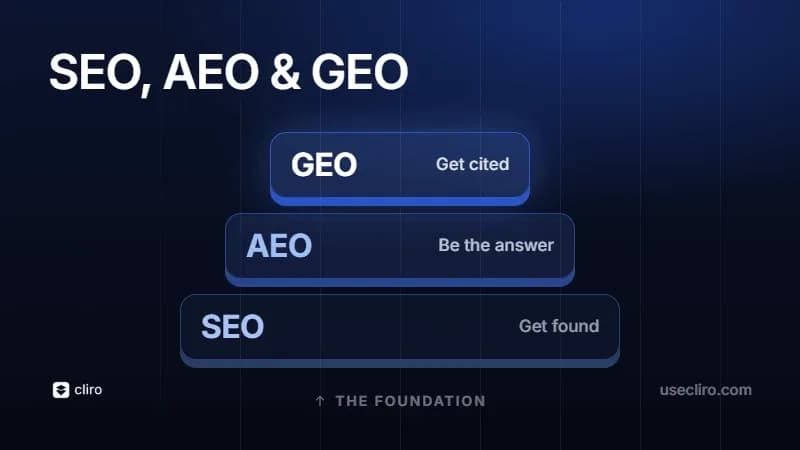
SEO, AEO and GEO: what they are and how they differ
SEO, AEO and GEO aren't the same, nor do they replace each other: they're three layers of one visibility strategy. We explain what each is and how they work together.
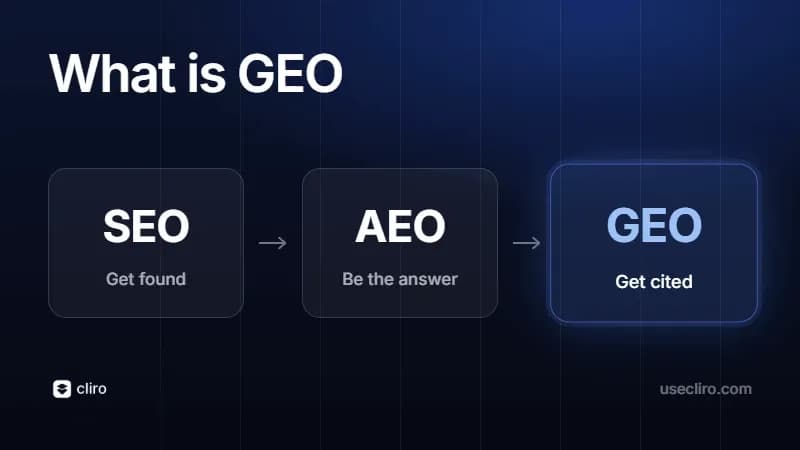
What is GEO (Generative Engine Optimization)? A complete guide
GEO (Generative Engine Optimization) means optimizing your brand to show up in answers from ChatGPT, Gemini and other AI. What it is, why it matters, how to do it and how to measure it.
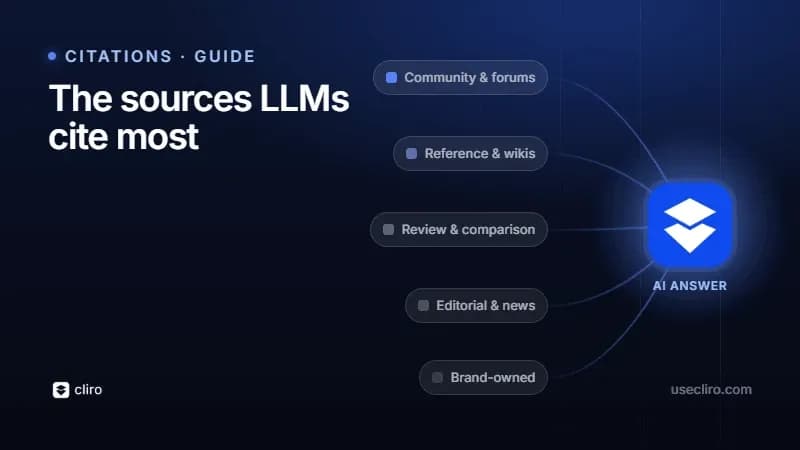
What kinds of sources do LLMs cite most?
What kinds of sources ChatGPT, Gemini and Perplexity cite most, according to the studies: why Reddit, Wikipedia and YouTube dominate, and what to do about it.