
What is GEO (Generative Engine Optimization)? A complete guide
GEO (Generative Engine Optimization) means optimizing your brand to show up in answers from ChatGPT, Gemini and other AI. What it is, why it matters, how to do it and how to measure it.


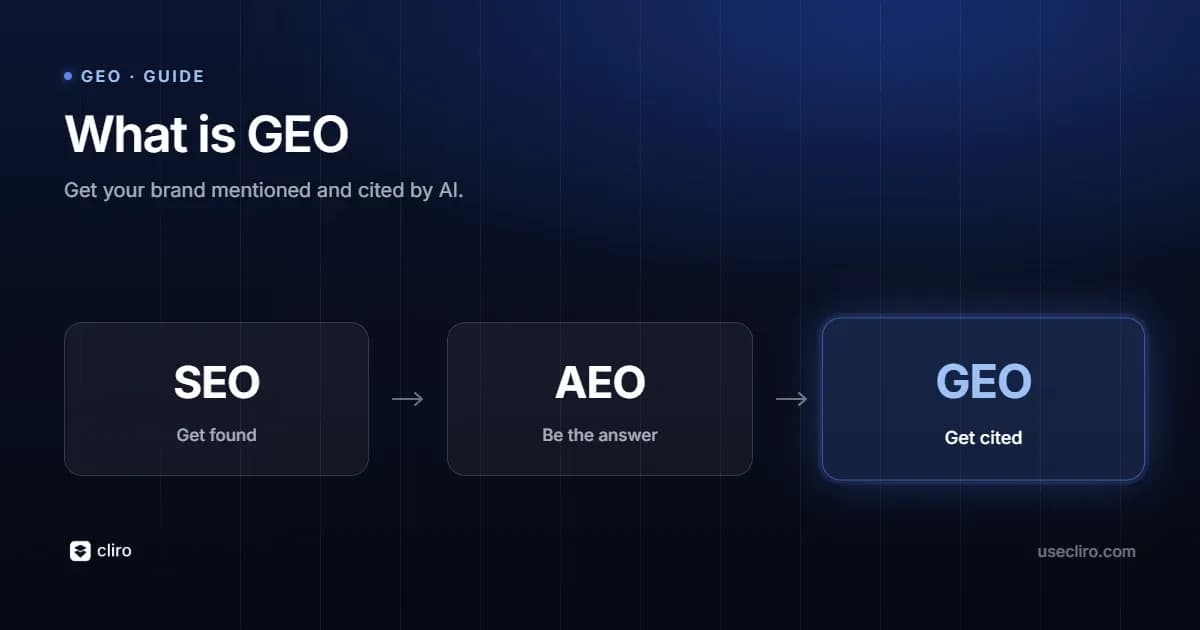
The way people search has changed. More and more, instead of typing a query into Google and scanning links, people ask ChatGPT, Gemini, Claude or Perplexity directly and get a ready-made answer. In that setting, ranking isn't enough: your brand has to appear inside the answer the AI generates. That's what GEO is about.
GEO (Generative Engine Optimization) is the practice of optimizing your brand and your content so that AI models —like ChatGPT, Gemini, Claude or Perplexity— mention, cite and recommend you when they generate their answers.
What is GEO (Generative Engine Optimization)?
GEO is the discipline focused on increasing a brand's presence within AI-generated answers. Unlike SEO, which competes for a position in a list of links, GEO competes to be part of the synthesis: that single answer the model builds by combining several sources. Success isn't measured in clicks, but in mentions, citations and recommendations inside those answers.
Why does GEO matter now?
Because search behavior is shifting toward AI answers. When AI answers directly, there's often no click: the answer is the final destination. If AI doesn't mention you, you're invisible in that channel —even if you rank first on Google. And in categories where people ask AI for recommendations, GEO decides whether you make it into the buyer's consideration set.
How do LLMs decide who to cite?
When someone asks, the model uses its knowledge and/or retrieves live sources (web search), then synthesizes an answer, sometimes with citations. To include you, your brand needs to: be present and understandable in the sources the model can access; be associated as an authority/entity for that topic; and be corroborated across multiple sources. The model favors content that's clear, structured, factual and backed by third parties.
Signals that improve your GEO visibility
- Entity authority: your brand existing as a recognizable, consistent entity (site, profiles, directories, coherent data).
- Third-party mentions: other sites, media, listings and communities talking about you. AI trusts what's corroborated by several sources.
- Structured, extractable content: direct answers, clear headings, lists, FAQ and schema. This is AEO, the foundation of GEO.
- Citable first-party data: statistics, studies and figures with a source. It's among the most cited by LLMs.
- Presence in the sources AI uses: media, Reddit and communities, directories and listings in your category.
- Technical base: AI crawlers can access (robots.txt), a published llms.txt, and content in the HTML.
- Consistency and freshness: up-to-date, coherent information everywhere.
How to do GEO, step by step
- Lock down the technical base: crawlability, llms.txt, robots.txt and HTML rendering.
- Structure your content for extraction (AEO): direct answers, questions, FAQ, schema.
- Build entity authority: consistent profiles and directories (Crunchbase, G2, etc. as relevant).
- Publish first-party data and comparisons that AI will want to cite.
- Earn third-party mentions: PR, category listings and communities.
- Measure and adjust: monitor which prompts you appear in and from which sources.
How is GEO measured?
You can't manage what you can't see. The key metrics are: visibility (how often you're mentioned), share of voice (vs competitors), position within the answer, sentiment, and the citations and sources AI uses. Since AI answers aren't public or stable, you need a tool that runs prompts and measures systematically. An AI visibility platform like Cliro does exactly that: it monitors your prompts, measures your visibility and share of voice, and shows you which sources AI cites when talking about your brand —across ChatGPT, Gemini, Claude, Perplexity and Grok.
GEO, AEO and SEO: how they fit together
Think of it as a funnel: SEO gets you found, AEO makes you the answer, and GEO gets AI to cite you. They're layers that support each other. For the full breakdown of all three, see our guide on the differences between SEO, AEO and GEO.
Common GEO mistakes
- Treating GEO as "SEO by another name" and ignoring entity authority and mentions.
- Accidentally blocking AI crawlers in robots.txt.
- Publishing content that doesn't render in the HTML (client-side only).
- Measuring only traffic, not mentions or citations.
- Expecting instant results: GEO builds authority over time.
Frequently asked questions
Is GEO the same as SEO?
No. SEO aims to rank links; GEO aims to get AI to cite you in its answers. SEO is the technical base GEO relies on.
Are GEO and AEO the same?
They overlap. AEO focuses on being the extracted answer; GEO, on being cited and reused by generative models. Most brands work on both.
How long does GEO take to show results?
It depends on your site's authority and your category's competition. It usually takes weeks to months, since it's about building authority.
How do I know if AI already mentions my brand?
By monitoring the relevant prompts with an AI visibility tool that measures how often and in what context you appear.
Do I have to drop SEO to do GEO?
No. SEO remains the prerequisite: without it, AI can't find or understand your content.

Written by
Federico Ergang
Cliro cofounder & CEO
Federico Ergang is cofounder and CEO of Cliro, the AI visibility and GEO platform for Latin America.
Related articles
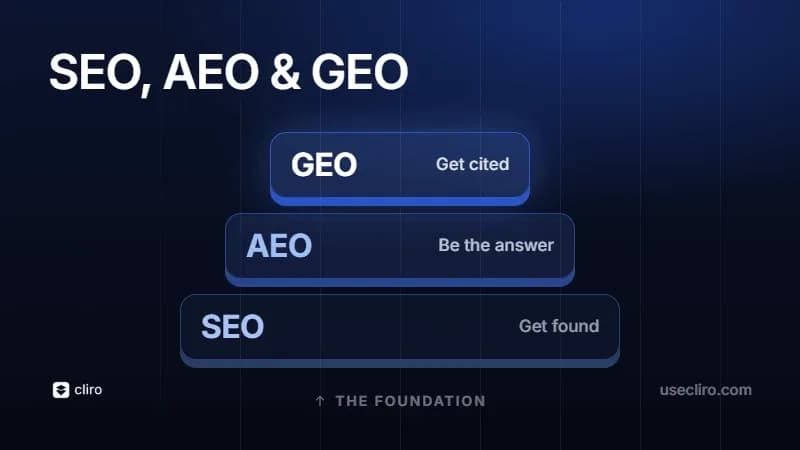
SEO, AEO and GEO: what they are and how they differ
SEO, AEO and GEO aren't the same, nor do they replace each other: they're three layers of one visibility strategy. We explain what each is and how they work together.
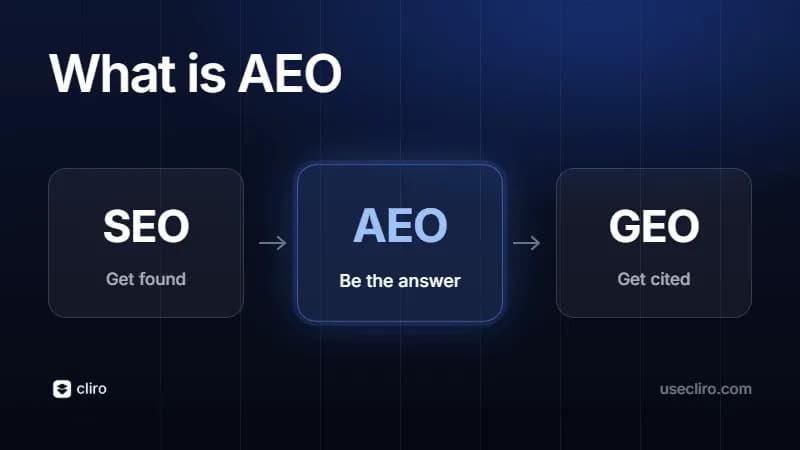
What is AEO (Answer Engine Optimization): a complete guide
AEO (Answer Engine Optimization) is optimizing your content to be the direct answer in AI Overviews, ChatGPT and voice search. What it is and how to do it.

How to know if your brand appears in ChatGPT
Does your brand show up in ChatGPT when someone asks for recommendations in your category? How to check it with a manual test, its limits and how to measure it for real.