Otterly Alternatives: The Best AI Visibility Tools for 2026
Otterly is the cheapest, simplest way into AI visibility tracking, but many teams outgrow pure monitoring. Here are the best Otterly alternatives for 2026, including Cliro for teams that want to act on the data, not just watch it.


Otterly is the cheapest and easiest on-ramp into AI visibility tracking, and for pure monitoring on a small budget it is hard to beat. Teams look for Otterly alternatives when the entry price stops being the real price, when they need to act on the data rather than just watch it, or when key engines sit behind add-ons. The right alternative depends on what you outgrew. For teams that want to move from monitoring to actually creating the content that closes the gap, Cliro is the strongest step up.
We are going to be fair about this: for a solo operator or a small team that just wants to start measuring, Otterly is genuinely one of the best first tools. This guide is for the point where you need more than it was built to give.
What is Otterly, and what does it do well?
Otterly is an AI search monitoring platform based in Austria that launched in 2024. You give it prompts, and it runs them daily across ChatGPT, Google AI Overviews, Perplexity, and Copilot, capturing the full AI response, logging which domains were cited, and tracking whether your brand appeared. It adds a Brand Visibility Index, citation and domain analysis, competitor benchmarking, AI prompt research, and a GEO Audit that checks on-page factors correlated with citation.
Its real strengths are price and simplicity. The Lite plan starts at about 29 dollars a month, there is a genuine free tier and trial, setup takes minutes, seats are unlimited, and it covers 50-plus markets even on the entry tier. For a small team moving from manual prompt checks in a spreadsheet to structured, repeatable data, Otterly is an excellent starting point, and its GEO Audit is unusually capable for the price. Credit where it is due.
Why do people look for Otterly alternatives?
- Monitoring without an execution layer. This is the big one, and it is consistent across reviews. Otterly shows you where you stand and why you are being skipped, but writing, optimizing, and publishing the content to fix it happens outside the platform. If you want measurement and content creation in one workflow, that gap creates friction.
- The 29 dollar price is a floor, not the real number. Core plans cover four engines, and two important ones, Google AI Mode and Gemini, are paid add-ons. Once you add the engines and prompts a real program needs, the effective cost climbs well past the sticker.
- Prompt-based pricing scales steeply. Lite includes a small prompt allowance for validation, and teams tracking multiple products, competitors, or regions move to Standard or Premium quickly.
- Shallow depth for bigger teams. Reviewers note limited historical data and competitive benchmarking that is lighter than enterprise tools, and recommendations that describe what is happening more than they prescribe what to do next.
What are the best Otterly alternatives in 2026?
Cliro, best for teams that want to act, not just watch
Cliro is the natural step up when you have outgrown pure monitoring. It tracks visibility, citations, sentiment, and competitors like Otterly does, and then adds the execution layer Otterly leaves out: a Content Agent that actually generates the content to close the gaps, through a pipeline with human approval before anything publishes. It includes every AI model on every plan, so there are no add-ons for Gemini or Google AI Mode, and it carries a technical site audit plus native Spanish and Latin America coverage. Pricing is higher than Otterly's entry, and that is the honest trade: Professional is 89 dollars a month with all models and the site audit, Business is 239 dollars a month adding the Content Agent and white-label, and there is a free tier to start. You pay more than Otterly's floor, but you get content creation and full engine coverage in one place instead of a monitor plus a separate content workflow. See how that works in which AI visibility tools actually create content.
The other alternatives, by use case
If execution is not your gap, other tools fit specific needs. Peec AI is a deeper, prompt-level monitor with strong sentiment and unlimited languages, a good move if you want richer monitoring without content creation. AthenaHQ adds a structured Action Center for assignable optimization tasks, though it is credit-based and pricier. Profound is the enterprise benchmark with unmatched prompt-volume research. For staying with cheap, simple monitoring, honestly, Otterly itself is hard to beat, so the alternatives here are for teams that need more than it offers.
Otterly vs. the alternatives: a quick comparison
| Tool | Entry price | All engines included | Creates content | Best for |
|---|---|---|---|---|
| Otterly | About 29 dollars | No. AI Mode and Gemini are add-ons | No. Recommendations only | Cheapest, simplest monitoring |
| Cliro | 89 dollars, free tier | Yes. All models on every plan | Yes. Pipeline with human approval | Acting on the data; all-in-one; Spanish/LATAM |
| Peec AI | About 89 dollars | Broad, unlimited languages | No | Deeper monitoring |
| AthenaHQ | About 295 dollars, credits | 8-plus on self-serve | Metered by credit | Action Center workflows |
| Profound | Enterprise, sales-led | 10-plus on Enterprise | Agents, capped | Deepest analytics |
How does Otterly pricing compare?
Otterly runs three self-serve tiers: Lite at about 29 dollars a month for a small prompt allowance and four core engines, Standard around 189 dollars for 100 prompts, and Premium in the 489 dollar range, with annual billing taking off roughly 15 percent. The two things that change the real cost are the prompt ceiling and the engine add-ons, since Google AI Mode and Gemini are extra. Cliro is not trying to win on the lowest sticker, and it will not: its Professional plan is 89 dollars a month. What that buys is different, all seven models with no add-ons, a monthly site audit, and, one tier up at 239 dollars, a Content Agent that creates the content Otterly can only recommend. If your need is the cheapest way to monitor, Otterly wins. If your need is one platform that measures and then acts, the comparison tilts the other way.
Should you switch from Otterly?
Stay on Otterly if you want the lowest-cost, simplest way to monitor AI search, you already have a content and SEO process to act on what you find, and the core engine coverage is enough for you. It is a genuinely good tool for that job.
Switch if you keep hitting prompt ceilings and add-on costs, if you want content creation in the same platform instead of exporting recommendations to a separate workflow, or if you want every engine included and native Spanish and Latin America coverage. In those cases Cliro is the most complete step up. Whatever you choose, capture a baseline first so you can attribute change to your work. See how to measure your brand's share of voice in AI, and for the three-way view of the monitors, our comparison of Cliro, Otterly, Peec AI and AthenaHQ.
Frequently asked questions
Is Otterly worth it?
Yes, for cheap, simple AI search monitoring. It is one of the easiest and most affordable ways to start, with a capable GEO audit for the price. It is less suited to teams that need content execution or full engine coverage without add-ons.
What is the main limitation of Otterly?
It monitors but does not execute. It tells you where you stand and why you are skipped, but writing and publishing the content to fix it happens outside the tool. Two key engines are also add-ons rather than included.
What is the best Otterly alternative?
For teams that want to act on the data rather than just watch it, Cliro, because it adds content generation with human approval, a site audit, and all engines included, on top of the monitoring Otterly does.
Is Otterly cheaper than the alternatives?
Usually yes at the entry level, its Lite plan is one of the cheapest in the category. The catch is that engine add-ons and prompt limits raise the real cost, and cheaper monitoring does not include content creation.

Written by
Federico Ergang
Cliro cofounder & CEO
Federico Ergang is cofounder and CEO of Cliro, the AI visibility and GEO platform for Latin America.
Related articles
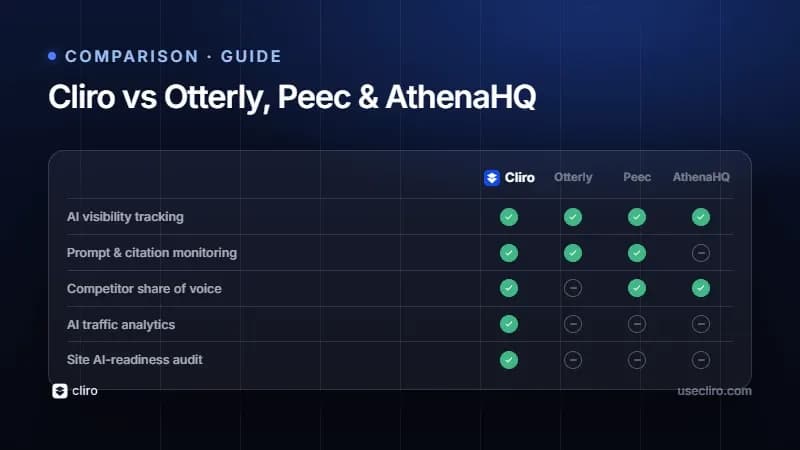
Cliro vs Otterly, Peec AI and AthenaHQ: a comparison
We compare Cliro with three alternatives: Otterly, Peec AI and AthenaHQ. Pricing, coverage, monitoring vs action and when each one fits.
Peec AI Alternatives: The Best AI Visibility Tools for 2026
Peec AI is one of the best AI visibility monitoring tools, but it only tracks. This guide compares the best Peec AI alternatives for 2026, from all-in-one platforms to enterprise technical tools, so you can pick one that helps you act on the data.
AthenaHQ Alternatives: The Best AI Visibility Tools for 2026
AthenaHQ is a capable, action-oriented GEO tool, but its credit-based pricing, missing free trial, and Enterprise-gated features send many teams looking. Here are the best AthenaHQ alternatives for 2026, including Cliro for flat pricing and content in one place.