What Are Citations in AI Search? The Sources Behind Answers
Citations are the sources an AI engine links to support its answer. Learn how AI citations work, why they matter, and how to earn more of them.


In AI search, citations are the sources an AI engine links to in order to support the answer it generates — the references that tell the user where the information came from. When Perplexity, an AI Overview or a search-connected assistant answers a question, citations are the footnotes or linked sources backing its claims. For brands, earning citations is the AI equivalent of earning a top ranking: it means the engine treated your content as authoritative enough to credit, and it can send referral traffic to your site.
This guide explains what AI citations are, how engines decide what to cite, why citations matter, the metrics used to measure them, and what earns more of them.
How do AI engines decide what to cite?
Most citing engines work by retrieval and synthesis: they retrieve sources relevant to the query, generate an answer grounded in those sources, and attach citations to the ones they used or trust most. Selection tends to favor content that is relevant to the specific claim, clearly authoritative, easy to extract a precise answer from, and accessible to the engine's crawler. Exactly which sources get cited varies by engine and changes over time, but the pattern is consistent: citations go to retrievable, credible, extractable content that directly supports the point being made.
Why do citations matter?
Citations carry three kinds of value. They drive referral traffic, since a linked citation is a path back to your site from the AI answer. They confer authority, because being cited signals the engine considers you a trustworthy source — a reputation effect that compounds. And they offer verifiability, letting users confirm claims against your content, which builds trust in your brand specifically. In an answer-first world where rankings matter less, citations are among the clearest signals that your content is winning in AI search.
How are citations measured?
Several metrics turn raw citations into insight, and they answer different questions.
| Metric | What it measures |
|---|---|
| Citation share of voice | Your citations as a share of all citations in the category |
| Citation rate | How often you're cited across a set of relevant prompts |
| Average citation position | Where your citation tends to appear among the sources |
| Citation velocity | How your citation count changes over time |
A caveat worth stating: citation position isn't consistent across engines — some order sources by relevance, others by appearance in the answer — so position metrics should be read per engine rather than pooled blindly.
What earns more citations?
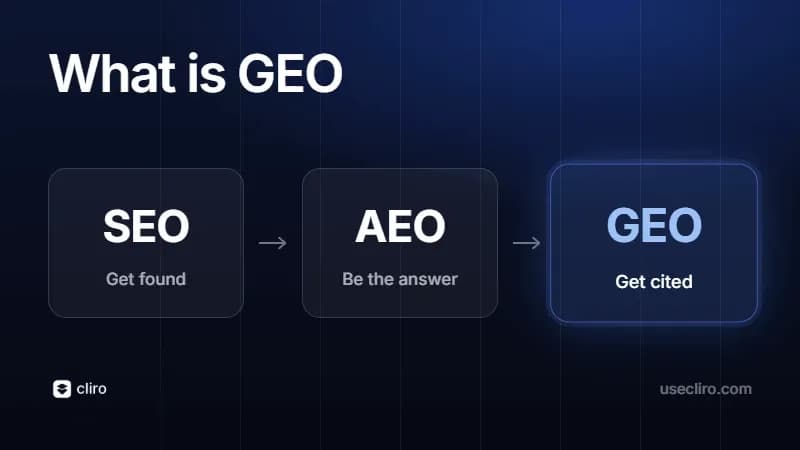
Earning citations is GEO applied to the source-selection moment:
- Be retrievable. Crawlable, rendered, content in the HTML so engines can actually read it.
- Be the precise answer. Self-contained passages that directly support a specific claim are easy to cite.
- Be authoritative. Clear authorship, accuracy and recognition make you a safe source to credit.
- Be fresh where it matters. For time-sensitive topics, up-to-date content is more citable.
- Be well-represented across the web, so engines encounter and trust your brand from multiple angles.
How do citations relate to mentions and rankings?
Citations sit alongside mentions and rankings as distinct signals. A mention names your brand in the answer text; a citation links to your content as a source — you can have either without the other. Compared with classic rankings, citations are the AI-era equivalent of being the linked, trusted result, but they're probabilistic and vary by engine and prompt rather than fixed in a list. Tracking citations specifically — not just rankings or mentions — is how you see whether your content is being credited in AI answers. [Editor: Cliro tie-in — citation metrics across engines are core product data; add a proprietary data point.]
Citations checklist
- Make content retrievable so engines can read it.
- Write self-contained answers that directly support specific claims.
- Build authority through clear authorship and accuracy.
- Keep time-sensitive content fresh.
- Track citation metrics — share of voice, rate, position, velocity — per engine.
- Distinguish citations from mentions when judging AI visibility.
Frequently asked questions
What are citations in AI search?
Citations are the sources an AI engine links to in order to support its generated answer — the references showing where the information came from. Earning them is the AI equivalent of a top ranking and can drive referral traffic.
How do AI engines decide what to cite?
Most retrieve relevant sources and attach citations to the ones they use or trust, favoring content that is relevant to the claim, authoritative, easy to extract a precise answer from, and accessible to the crawler. Selection varies by engine and over time.
Why do AI citations matter?
They drive referral traffic, confer authority by signaling the engine trusts your content, and offer verifiability that builds trust in your brand. In an answer-first world, citations are a clear sign your content is winning in AI search.
How are AI citations measured?
Through metrics like citation share of voice, citation rate, average citation position and citation velocity. Citation position varies by engine, so it should be read per engine rather than pooled.
How do I earn more citations?
Make content retrievable, write self-contained passages that directly support specific claims, build authority and accuracy, keep time-sensitive content fresh, and ensure your brand is well-represented across the web.

Written by
Federico Ergang
Cliro cofounder & CEO
Federico Ergang is cofounder and CEO of Cliro, the AI visibility and GEO platform for Latin America.
Related articles
What Is AI Visibility? How Brands Appear in AI Search
AI visibility is how present your brand is in AI-generated answers. Learn what drives it, how to measure it, and why it's the new frontier of search.
Mention vs. Citation in AI Search: The Difference
In AI search, a mention names your brand while a citation links to your source. Learn the difference between them and why both matter for AI visibility.
What is GEO (Generative Engine Optimization)? A complete guide
GEO (Generative Engine Optimization) means optimizing your brand to show up in answers from ChatGPT, Gemini and other AI. What it is, why it matters, how to do it and how to measure it.