
What Is AI Visibility? How Brands Appear in AI Search
AI visibility is how present your brand is in AI-generated answers. Learn what drives it, how to measure it, and why it's the new frontier of search.


AI visibility is the measure of how present and prominent your brand is within the answers generated by AI engines — how often, how favorably, and how prominently you are mentioned and cited when people ask AI about your category. It is the AI-era counterpart to search rankings: as users increasingly rely on ChatGPT, Gemini, Claude, Perplexity and AI Overviews for answers, being visible inside those answers becomes as important as ranking once was. AI visibility is the outcome that Generative Engine Optimization works to improve.
This guide explains what AI visibility is, why it matters now, the components that make it up, how it differs from rankings, what drives it, and how to measure it.
Why does AI visibility matter now?
AI visibility matters because the path people take to information is shifting from clicking ranked links to reading synthesized AI answers. When an AI engine answers a question in your category, the brands it mentions and cites shape what the user learns and considers — and the brands it omits are effectively invisible at the moment of decision. A company can rank well in traditional search yet be absent from AI answers, losing presence exactly where attention is moving. Tracking and improving AI visibility addresses that gap.
What are the components of AI visibility?
AI visibility is not a single number; it's a composite of several measurable dimensions.
| Component | Question it answers |
|---|---|
| Mention rate | How often is the brand named in relevant AI answers? |
| Citation rate | How often is the brand cited with a link to its source? |
| Share of voice | How does the brand's presence compare to competitors in the category? |
| Sentiment | Is the brand described positively, neutrally or negatively? |
| Prominence | Is the brand featured early and centrally, or mentioned in passing? |
A complete view of AI visibility combines these — being mentioned often but described poorly, or cited rarely despite frequent mentions, each tells a different story.
How does AI visibility differ from search rankings?
Rankings are positional and relatively stable: a page holds a place in a list for a query. AI visibility is probabilistic and variable: the same prompt can yield different answers across engines, sessions and time, so visibility is a tendency to appear rather than a fixed slot. It's also multi-engine by nature, spanning several AI products rather than one results page. And the win condition is being named as a source inside an answer, not occupying a position. These differences mean AI visibility must be sampled and tracked over many prompts and engines, not read off a single ranking.
What drives AI visibility?
AI visibility is driven by the same foundations as GEO: content that is retrievable and well-structured, demonstrably authoritative and trustworthy, and well-represented across the web that engines draw on. Consistent, accurate descriptions of your brand across many reputable sources help engines form a stable understanding of who you are and what you do, which makes you a more reliable choice to mention. In short, you earn AI visibility by being the kind of credible, clearly-described, easily-retrieved source an engine is comfortable surfacing.
How do you measure and improve AI visibility?
Because a single prompt isn't representative, measuring AI visibility means systematically querying many relevant prompts across multiple engines and tracking the components over time — mention rate, citation rate, share of voice, sentiment and prominence — ideally compared against competitors. Improving it follows from the measurement: find the prompts where you're absent or poorly represented, identify the authoritative sources the engines are citing instead, and strengthen your content, structure and web presence to close those gaps. [Editor: Cliro tie-in — this is precisely the product's function; link to it and add a proprietary AI Share of Voice data point.]
AI visibility checklist
- Treat AI visibility as the new ranking — measure it deliberately.
- Track all components: mentions, citations, share of voice, sentiment, prominence.
- Sample across engines and many prompts, not a single query.
- Benchmark against competitors.
- Strengthen retrievability, authority and structure to earn presence.
- Build consistent brand description across reputable sources.
Frequently asked questions
What is AI visibility?
AI visibility is how present and prominent a brand is within AI-generated answers — how often, how favorably and how prominently it is mentioned and cited when people ask AI about its category. It is the AI-era counterpart to search rankings.
Why does AI visibility matter?
Because users increasingly rely on AI answers instead of ranked links. Brands an AI mentions shape what users learn and consider, while omitted brands are invisible at the moment of decision — even if they rank well in traditional search.
What are the components of AI visibility?
Mention rate, citation rate, share of voice against competitors, sentiment, and prominence. A complete view combines them, since each reveals a different aspect of presence.
How is AI visibility different from rankings?
Rankings are positional and stable; AI visibility is probabilistic, varies by engine, session and time, spans multiple AI products, and is won by being named as a source rather than holding a position.
How do you measure AI visibility?
By querying many relevant prompts across multiple engines and tracking mention rate, citation rate, share of voice, sentiment and prominence over time, benchmarked against competitors.

Written by
Federico Ergang
Cliro cofounder & CEO
Federico Ergang is cofounder and CEO of Cliro, the AI visibility and GEO platform for Latin America.
Related articles
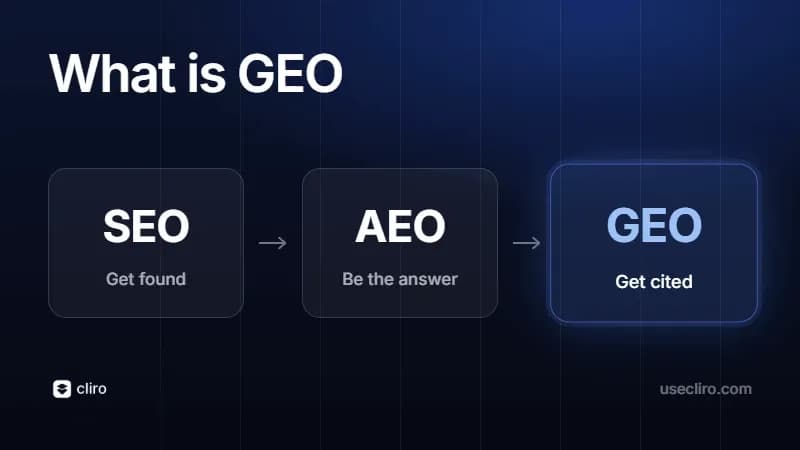
What is GEO (Generative Engine Optimization)? A complete guide
GEO (Generative Engine Optimization) means optimizing your brand to show up in answers from ChatGPT, Gemini and other AI. What it is, why it matters, how to do it and how to measure it.
What Is an Answer Engine? How It Differs From Search
An answer engine returns a direct answer instead of a list of links. Learn how answer engines like Perplexity work, and how they differ from search engines.