
What Is a Large Language Model (LLM)? A Clear Guide
A large language model (LLM) is an AI trained on vast text to predict and generate language. Learn how LLMs work, what they can't do, and why they matter for search.


A large language model (LLM) is an artificial intelligence system trained on enormous amounts of text to understand and generate human language by predicting the most likely next piece of text given what came before. LLMs are the technology behind ChatGPT, Gemini, Claude and the AI features in modern search. Understanding what an LLM is — and what it can and can't do — is the foundation for everything in generative search, because the way LLMs work explains both why AI answers are so fluent and why they sometimes get things wrong.
This guide explains what an LLM is, how it's trained, how it generates text, what it can and can't do, its role in search, and its key limitations.
How is an LLM trained?
An LLM learns from a vast corpus of text — a large slice of the public web, books and other written material. During training, it repeatedly tries to predict the next token (a word or fragment) in a sequence and adjusts billions of internal values, called parameters, each time it's wrong. Over trillions of examples, this process encodes statistical patterns of language: grammar, facts, styles and relationships between concepts. The result is a model that, given some input, can produce text that's coherent and contextually appropriate. Crucially, this knowledge is frozen at a training cutoff unless the model is connected to live information.
How does an LLM generate text?
At generation time, an LLM works one token at a time: given the prompt and everything generated so far, it estimates a probability distribution over possible next tokens and picks one, then repeats. This is why LLM output is fluent but fundamentally probabilistic — it's producing the most plausible continuation, not retrieving a stored answer. The same mechanism that makes LLMs flexible and articulate also means they can state something false just as confidently as something true, because plausibility, not verified accuracy, drives each choice.
What can and can't LLMs do?
| LLMs are good at | LLMs struggle with |
|---|---|
| Fluent writing, summarizing, explaining | Guaranteeing factual accuracy |
| Following instructions and reasoning over text | Knowing events after their training cutoff |
| Translating and rephrasing | Reliable math or precise citation without tools |
| Synthesizing many sources into one answer | Distinguishing confident guesses from facts |
What role do LLMs play in search?
LLMs are the engine of generative and answer-based search. When you ask ChatGPT, Gemini, Claude or a Google AI Overview a question, an LLM composes the answer. In search-connected modes, the LLM is paired with retrieval — pulling current web sources and grounding the answer in them — which is how it cites sources and stays up to date. This pairing matters for brands: the LLM decides how to phrase an answer and which retrieved sources to lean on, so being a clear, retrievable, authoritative source is how you influence what the model says.
What are the key limitations of LLMs?
Three limitations shape everything downstream. First, hallucination: because output is probabilistic, an LLM can fabricate plausible-sounding but false statements, including about brands. Second, the training cutoff: without retrieval, a model doesn't know recent events. Third, opacity: it's hard to know exactly why a model produced a given answer. Techniques like retrieval-augmented generation and grounding exist specifically to mitigate the first two by tying answers to real, current sources — which is also why retrievable, well-structured content has become so valuable.
How do LLMs connect to GEO and AI visibility?
Generative Engine Optimization exists because LLMs now mediate how people find information. Since an LLM composes the answer and, when grounded, selects which sources to cite, your visibility depends on being the kind of content an LLM can retrieve, trust and reuse. The probabilistic, source-grounded nature of LLMs is exactly why AI visibility is measured across many prompts and engines rather than as a fixed ranking. [Editor: optional Cliro tie-in on optimizing for how LLMs select and cite sources.]
LLM checklist for brands
- Understand answers are probabilistic, not retrieved facts.
- Expect hallucination and monitor what models say about you.
- Favor search-connected behavior by being retrievable and current.
- Be a clear, authoritative source an LLM can trust and cite.
- Structure content so it's easy to extract and reuse.
- Measure across prompts and engines, not as a single ranking.
Frequently asked questions
What is a large language model?
A large language model (LLM) is an AI system trained on enormous amounts of text to understand and generate human language by predicting the most likely next piece of text. LLMs power ChatGPT, Gemini, Claude and AI features in search.
How does an LLM work?
It's trained to predict the next token in a sequence across trillions of examples, encoding patterns of language in billions of parameters. At generation time it produces text one token at a time, choosing the most plausible continuation.
Why do LLMs make mistakes?
Because output is probabilistic — the model produces plausible continuations, not verified facts — it can state falsehoods confidently. It also lacks knowledge of events after its training cutoff unless connected to live retrieval.
What role do LLMs play in search?
LLMs compose the answers in generative and answer-based search. In search-connected modes they're paired with retrieval to ground answers in current sources and cite them, which is how they stay up to date.
How do LLMs relate to AI visibility?
Since an LLM composes answers and selects which sources to cite, a brand's AI visibility depends on being retrievable, trustworthy content the model can reuse. Their probabilistic nature is why visibility is measured across many prompts and engines.

Written by
Federico Ergang
Cliro cofounder & CEO
Federico Ergang is cofounder and CEO of Cliro, the AI visibility and GEO platform for Latin America.
Related articles
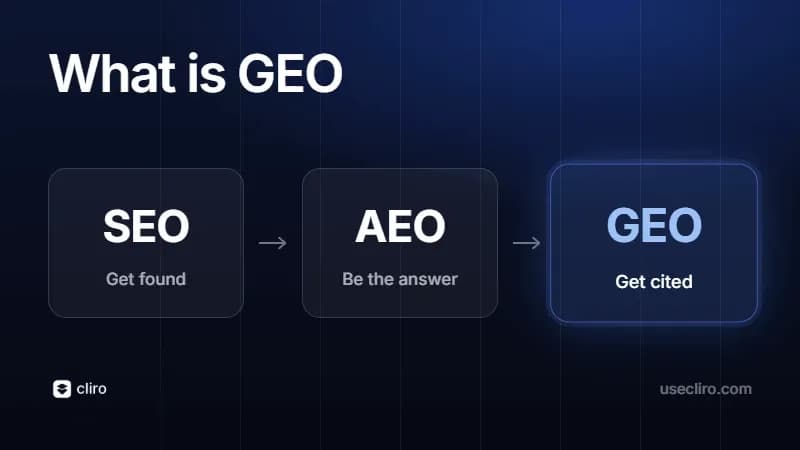
What is GEO (Generative Engine Optimization)? A complete guide
GEO (Generative Engine Optimization) means optimizing your brand to show up in answers from ChatGPT, Gemini and other AI. What it is, why it matters, how to do it and how to measure it.
What Is an Answer Engine? How It Differs From Search
An answer engine returns a direct answer instead of a list of links. Learn how answer engines like Perplexity work, and how they differ from search engines.