
What Is Question-Answer Format? Content Built for AI
Question-answer format structures content as questions with clear, brief answers — ideal for AI and assistants to reuse. Learn how and when to use it.


Question-answer format is a way of structuring content as explicit questions followed by clear, direct answers — a pattern that engines and assistants can easily reuse as the response to a query. Instead of burying an answer inside a long narrative, it poses the real question a person would ask, usually as a heading, and answers it immediately underneath. This mirrors how people query AI and search, and it makes content far easier to extract, cite and present as a direct answer.
This guide explains what question-answer format is, why it works so well for AI and extraction, how to structure it, its relationship to FAQ sections and schema, and where not to overuse it.
Why does question-answer format work for AI?
Question-answer format works because it matches the shape of the demand. People increasingly query in full questions — typed into search, spoken to assistants, or prompted to AI engines — so content that literally contains the question and its answer is a direct match for what the engine is looking for. It also makes extraction trivial: the question signals exactly what the following passage answers, and the answer sits in a clean, liftable block. Featured snippets, voice answers and AI citations all favor this structure because it removes the work of guessing where the answer is.
How should a question-answer block be structured?
An effective question-answer block follows a consistent shape, and each part does a job:
- Question as heading. Use the real, natural-language question as an H2 or H3 — phrased the way a person would actually ask it.
- Answer first. Open with the direct answer in the first sentence, before any elaboration.
- Keep it concise. A tight answer of roughly 40–60 words is ideal for reuse; add depth in following sentences if needed.
- Make it self-contained. The answer should make sense on its own, without relying on earlier sections.
This pattern is the practical intersection of two other AEO habits — answer-first writing and self-contained content — applied at the level of a single question.
How does it relate to FAQ sections and schema?
An FAQ section is question-answer format applied as a dedicated block, usually at the end of a page, gathering the common follow-up questions on a topic. Its value is twofold: it serves readers who scan for a specific question, and it can be marked up with FAQPage structured data, which labels each question-and-answer pair so search engines understand the structure explicitly. That markup can make a page eligible for richer presentation and reinforces, in machine-readable form, that the page directly answers real questions. Pairing a well-written FAQ with FAQPage schema is one of the most reliable AEO moves available.
Where should you use — and not overuse — question-answer format?
Question-answer format fits naturally wherever real questions exist: definitional content ("what is…"), how-to and troubleshooting, comparisons ("X vs Y"), and dedicated FAQ sections. It is less appropriate as a wrapper for everything. Narrative explanations, stories, persuasive arguments and flowing analysis lose their coherence if forced into a rigid Q&A grid. The goal is not to convert every paragraph into a question, but to surface the genuine questions your audience asks and answer them cleanly, while letting other content keep its natural form.
How does question-answer format relate to AEO and GEO?
Question-answer format is a core technique of both AEO and GEO. For Answer Engine Optimization, it produces the clean question-and-answer pairs that featured snippets and voice assistants present directly. For Generative Engine Optimization, it gives AI engines well-labeled, self-contained answers that are easy to retrieve and cite when composing a response. Because it aligns content with how questions are actually asked across every modern surface, it improves visibility on traditional snippets and generative answers at the same time. [Editor: Cliro tie-in — add a data point on Q&A-structured content earning more AI citations.]
Question-answer format checklist
- Find the real questions your audience asks (People Also Ask, search data, support tickets).
- Use the question as a heading, phrased naturally.
- Answer first, in a concise, self-contained block.
- Add an FAQ section for common follow-ups.
- Mark up FAQs with FAQPage schema.
- Don't force it onto narrative or persuasive content that reads better as prose.
Frequently asked questions
What is question-answer format?
Question-answer format structures content as explicit questions followed by clear, direct answers — typically a natural-language question as a heading with the answer immediately underneath — so engines and assistants can easily reuse it.
Why is question-answer format good for AI?
People query in full questions, so content containing the question and its answer is a direct match, and the structure makes the answer easy to extract and cite. Featured snippets, voice answers and AI citations all favor it.
How do I structure a question-answer block?
Use the real question as a heading, answer it directly in the first sentence, keep the core answer concise (around 40–60 words), and make it self-contained so it stands on its own.
What is the link between question-answer format and FAQ schema?
An FAQ section is question-answer format applied as a dedicated block, and FAQPage structured data marks up each question-and-answer pair so engines understand the structure explicitly, which can enable richer presentation.
When should I not use question-answer format?
Avoid forcing it onto narrative, persuasive or flowing analytical content, which loses coherence in a rigid Q&A grid. Use it where real questions exist and let other content keep its natural form.

Written by
Federico Ergang
Cliro cofounder & CEO
Federico Ergang is cofounder and CEO of Cliro, the AI visibility and GEO platform for Latin America.
Related articles
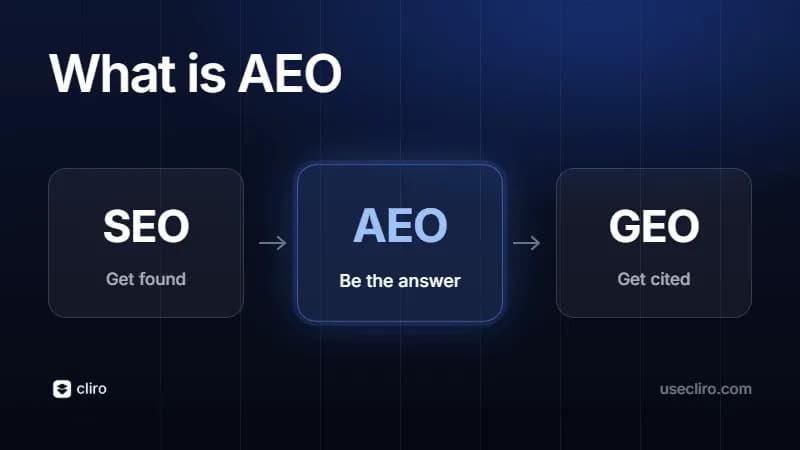
What is AEO (Answer Engine Optimization): a complete guide
AEO (Answer Engine Optimization) is optimizing your content to be the direct answer in AI Overviews, ChatGPT and voice search. What it is and how to do it.
What Is Self-Contained Content? Writing for AI Citation
Self-contained content is text that stands on its own, so AI can extract it without losing meaning. Learn the principles and how to write it for AEO.
What Is a Featured Snippet? How to Win Position Zero
A featured snippet is the answer box Google shows above the results. Learn the types, how to win one, and how snippets connect to AI Overviews.