What Is Self-Contained Content? Writing for AI Citation
Self-contained content is text that stands on its own, so AI can extract it without losing meaning. Learn the principles and how to write it for AEO.


Self-contained content is text written so that each passage stands on its own and makes complete sense without depending on the paragraphs around it — which makes it easy for an AI engine to extract and reuse without losing meaning. When a sentence relies on "as mentioned above" or an unexplained "it," lifting that sentence out breaks it. Self-contained writing avoids that dependency, so any block can be quoted, cited or summarized accurately on its own. It is one of the most important habits in writing for AI citation.
This guide explains what self-contained content is, why it matters for extraction and AI citation, the problem with context-dependent writing, the principles that make content standalone, and a clear before-and-after example.
Why does self-contained content matter for AI?
AI engines and search features rarely use a whole page — they extract pieces of it. Retrieval-augmented systems break pages into chunks, retrieve the chunks most relevant to a query, and synthesize an answer from those fragments. Featured snippets and voice answers do the same on a smaller scale. The unit of reuse, in other words, is the passage, not the page. If a passage only makes sense in the flow of the full article, it loses meaning the moment it's pulled out — and an engine will either skip it or misrepresent it. Self-contained passages survive this extraction intact, which is exactly why they get cited.
What is the problem with context-dependent writing?
Most writing is built for linear reading, where each sentence leans on the ones before it. That's natural for a human reading top to bottom, but it fails under extraction. A passage that begins "As we saw earlier, this approach has three drawbacks" is meaningless on its own: what approach, and where was earlier? Pronouns without nearby antecedents ("it," "they," "this"), references to other sections ("see above," "in the next part"), and headings that only make sense in sequence all create context dependency. Each is a thread connecting the passage to the rest of the page — and extraction cuts every thread.
What are the principles of self-contained content?
Writing standalone passages comes down to a handful of repeatable habits:
- Name the subject explicitly. Repeat the actual noun instead of relying on "it" or "they" when a passage could be read alone.
- Avoid cross-references. Replace "as mentioned above" and "see the next section" with the information itself.
- Make headings self-explanatory. A heading should describe its section's content on its own, not depend on the previous heading.
- Open passages with their own context. State what the paragraph is about before elaborating, so the first sentence frames the rest.
- Define terms in place (or link to a definition) rather than assuming the reader saw an earlier explanation.
- Front-load the answer. Put the key point first so a clean, complete statement sits at the top of the passage.
None of this means repeating yourself constantly or writing robotically. It means making each meaningful block resilient enough to stand alone if an engine — or a reader skimming — lands on it directly.
How does self-contained content relate to chunking and embeddings?
Retrieval systems convert text into chunks and then into embeddings — numerical representations of meaning used to match passages to a query. A chunk that is self-contained carries a clear, complete meaning, so its embedding accurately represents a coherent idea and matches the right queries. A chunk full of unresolved references represents a fragment of an idea, so it matches poorly and, even when retrieved, gives the model an incomplete piece to work with. Self-contained writing therefore improves both whether your content is retrieved and how faithfully it's used.
What does self-contained content look like in practice?
| Context-dependent (weak) | Self-contained (strong) |
|---|---|
| "As mentioned above, it offers three benefits." | "Answer Engine Optimization offers three benefits: more featured snippets, voice presence, and AI citations." |
| "This makes it the better option here." | "A self-referencing canonical tag is the safer default because it removes ambiguity about the preferred URL." |
| "See the previous section for why." | "INP replaced FID in March 2024 because it measures responsiveness across all interactions, not just the first." |
In each strong version, the passage names its subject, includes the necessary facts, and would be quoted accurately if lifted out — no surrounding context required.
How does this connect to snippets and AI citation?
Self-contained content is the foundation of both featured snippets and AI citation. A featured snippet is, by definition, a passage Google judged it could lift and present on its own — so the more self-contained your key passages, the more eligible they are. AI engines apply the same logic at scale when choosing what to cite. Self-contained writing pairs naturally with question-answer format and clear structure: together they make a page a collection of clean, extractable answers rather than a single block that must be read in full. [Editor: Cliro tie-in — add a data point on how self-contained, extractable passages correlate with citations.]
Self-contained content checklist
- Could each key passage be quoted alone and still make sense? If not, fix it.
- Name subjects explicitly instead of relying on pronouns.
- Remove cross-references like "as above" and "see below."
- Write self-explanatory headings.
- Front-load the key point in each passage.
- Define terms in place or link to a definition.
Frequently asked questions
What is self-contained content?
Self-contained content is text written so each passage makes complete sense on its own, without depending on surrounding paragraphs. This lets AI engines and search features extract and reuse a passage without losing its meaning.
Why does self-contained content matter for AI?
AI engines extract passages, not whole pages. A self-contained passage survives extraction intact and can be cited accurately, while a context-dependent passage loses meaning when lifted out and is often skipped or misrepresented.
How do I make content self-contained?
Name subjects explicitly instead of using bare pronouns, remove cross-references like "as mentioned above," write self-explanatory headings, front-load the key point, and define terms in place.
How does self-contained content relate to chunking?
Retrieval systems split text into chunks and embed them to match queries. A self-contained chunk carries a clear, complete meaning, so it is retrieved more accurately and used more faithfully than a chunk full of unresolved references.
Is self-contained content the same as question-answer format?
They are complementary. Question-answer format structures content as questions with direct answers, and self-contained writing ensures each answer stands alone. Together they make a page a set of clean, extractable answers.

Written by
Federico Ergang
Cliro cofounder & CEO
Federico Ergang is cofounder and CEO of Cliro, the AI visibility and GEO platform for Latin America.
Related articles
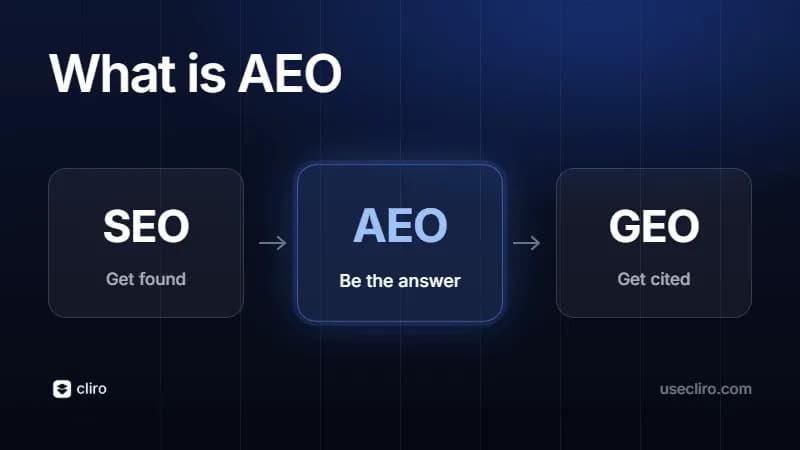
What is AEO (Answer Engine Optimization): a complete guide
AEO (Answer Engine Optimization) is optimizing your content to be the direct answer in AI Overviews, ChatGPT and voice search. What it is and how to do it.
What Is an Answer Engine? How It Differs From Search
An answer engine returns a direct answer instead of a list of links. Learn how answer engines like Perplexity work, and how they differ from search engines.