What Is Search Intent? The 4 Types and How to Match It
Search intent is the real goal behind a query. Learn the four types of intent, how to read it from the SERP, and why matching intent beats matching the keyword.


Search intent is the real goal behind a search query — what the person actually wants to accomplish, whether that's to learn something, find a specific site, compare options, or buy. It is the difference between the words a searcher types and the outcome they are after. Because modern search engines optimize for satisfying that outcome rather than matching the words, getting intent right is the single most important decision in optimizing any page: good SEO answers the intent, not just the keyword.
This guide explains what search intent is, the four types it falls into, how to identify the intent behind a keyword by reading the results page, why intent matching beats keyword matching, how intent maps to the buyer's journey, and how it works in AI search.
What is search intent, exactly?
Search intent (also called user intent or query intent) is the underlying motivation behind a search. Every query is a compressed expression of a need, and the engine's job is to infer that need and return results that satisfy it. When Google evaluates whether your page deserves to rank, the first thing it is implicitly testing is whether the page serves the intent its algorithms have associated with that query.
This reframes what "relevance" means. A page can contain the exact keyword and still be irrelevant if it answers the wrong need — for example, a product page targeting a query where people clearly want a how-to guide. Conversely, a page that never repeats the query verbatim can rank at the top if it satisfies the intent better than anything else. Intent, not keyword density, is the axis the system rewards.
What are the four types of search intent?
Most queries resolve to one of four intent categories. Recognizing which one a query belongs to dictates the type of page you need to build.
| Intent | The searcher wants to… | Typical signals / modifiers | Example query |
|---|---|---|---|
| Informational | Learn or understand something | how, what, why, guide, tutorial, ideas, examples | "what is search intent" |
| Navigational | Reach a specific site, page or brand | brand names, "login", "official", product names | "google search console login" |
| Commercial investigation | Compare options before deciding | best, top, review, vs, comparison, alternatives | "best keyword research tools" |
| Transactional | Take an action or make a purchase | buy, price, discount, near me, order, sign up | "buy ahrefs subscription" |
These categories are not always tidy. A query like "running shoes" sits between commercial investigation and transactional, and the right answer is whatever the dominant intent on the results page turns out to be — which is exactly why you read the SERP rather than guess.
How do you identify the intent behind a keyword?
The most reliable signal is not the query's wording but the results it already returns. Google has spent enormous resources learning what satisfies each query; the current page-one results are its verdict, and you should treat them as the answer key.
- Read the content type that ranks. Are the top results blog posts, product pages, category pages, or tools? That is the intent, made visible.
- Read the SERP features. A featured snippet or "People Also Ask" block signals informational intent; shopping carousels and ads signal transactional; a knowledge panel often signals navigational.
- Read the query modifiers. Words like "best", "vs", "how to", "buy" or "near me" are strong, explicit intent markers.
If the page-one results are uniformly buying guides and you publish a glossary definition, you are arguing with Google about what the query means — and Google holds the data. Match the validated intent, or differentiate with a clear reason.
What is intent matching, and why does it beat keyword matching?
Intent matching means aligning three things on your page with the dominant intent of the query — often called the three Cs:
- Content type: the format Google expects (article, product page, category, landing page, tool).
- Content format: the structure within that type (a step-by-step guide, a listicle, a comparison table, an opinion piece).
- Content angle: the dominant selling point or perspective (for beginners, for 2026, free, fastest).
Intent mismatch is one of the most common and least diagnosed reasons strong content fails to rank. Teams pour effort into a well-written page, see it stall, and assume they need more backlinks or more keywords — when the real problem is that the page type does not match what searchers (and therefore Google) want for that query. Fixing the match usually moves the needle faster than any amount of link building.
Can a single query have mixed or shifting intent?
Yes, in two ways. Some queries are genuinely ambiguous: "apple" could be the fruit or the company, so Google hedges by showing a mix of results, and a single dominant intent may not exist. For these, the safest strategy is to target the intent you can credibly serve and accept that you will not own the whole page.
Intent also shifts over time. As real-world behavior changes, Google re-interprets queries and reshuffles the results to match — a page that ranked for a year can lose position not because it got worse, but because the intent behind its keyword moved. This is why intent is not a one-time classification but something to re-check whenever rankings change unexpectedly.
How does search intent map to the buyer's journey?
Intent types line up neatly with the marketing funnel, which makes search intent a planning tool as much as an SEO concept. The pattern lets you build content for every stage and guide visitors from learning to buying.
| Funnel stage | Dominant intent | What to publish |
|---|---|---|
| Top (awareness) | Informational | Guides, definitions, how-tos that build trust and topical authority |
| Middle (consideration) | Commercial investigation | Comparisons, "best of" lists, reviews, alternatives pages |
| Bottom (decision) | Transactional | Product, pricing and sign-up pages |
Navigational intent sits outside this flow — it captures people already looking for you, and the job there is simply to make sure your own pages are the unmistakable result.
How does search intent work in AI search?
In AI search — ChatGPT, Gemini, Claude, Perplexity and Google's AI Overviews — intent becomes more explicit, not less important. Because people write longer, conversational prompts, they often state their intent directly ("compare the two cheapest options for a beginner"), which removes the guesswork that classic short queries required. The challenge moves from inferring intent to fully satisfying it: answer engines reward content that resolves the intent completely and in a self-contained way, because they extract and synthesize rather than send a click.
For Generative Engine Optimization (GEO), this means a page is judged on whether it answers the whole intent — the primary question and the likely follow-ups — clearly enough to be cited. Tracking which intents and prompts trigger a brand mention across AI engines becomes the equivalent of tracking which keywords you rank for in classic search. [Editor: insert a Cliro AI Visibility data point here — e.g. coverage across informational vs commercial prompts in your category.]
How do you optimize a page for search intent?
- Classify the intent first. Before writing, decide which of the four types the target query belongs to.
- Read the SERP and match the three Cs. Mirror the content type, format and angle that already rank, unless you have a real reason to differ.
- Answer first. Put the direct answer near the top so both readers and AI systems get it immediately.
- Be complete. Cover the primary question and the obvious follow-ups so the searcher has no reason to return to the results.
- Don't mix intents on one page. A page that tries to inform and sell at once usually does neither well; split them and link between.
- Re-check when rankings move. If a page slips, test whether the intent behind its keyword has shifted before changing anything else.
Frequently asked questions
What are the four types of search intent?
Informational (to learn), navigational (to reach a specific site), commercial investigation (to compare before buying), and transactional (to take an action or purchase). Most queries map to one dominant type.
How do I find the search intent of a keyword?
Look at the results that already rank for it. The content type that dominates page one, the SERP features present, and the query's modifiers together reveal the intent Google has validated for that query.
Why is search intent more important than the keyword?
Search engines reward pages that satisfy the searcher's goal, not pages that repeat the query. A page with the exact keyword still fails if it answers the wrong need, while a page that matches intent can rank without repeating the keyword.
Can one keyword have more than one intent?
Yes. Some queries are ambiguous and return mixed results, and intent can shift over time as behavior changes, prompting Google to reinterpret the query and reshuffle the results.
How does search intent apply to AI search?
In AI search people state intent more explicitly through conversational prompts, so the priority shifts to fully satisfying the intent. Answer engines favor content that resolves the question completely and self-containedly, making it eligible to be cited.

Written by
Federico Ergang
Cliro cofounder & CEO
Federico Ergang is cofounder and CEO of Cliro, the AI visibility and GEO platform for Latin America.
Related articles
What Is a Keyword in SEO? Types, Intent and Research
A keyword is the word or phrase someone types into a search engine. Learn how keywords are classified, measured and researched — and how they work in AI search.
What Is SEO? Search Engine Optimization Explained
SEO is the practice of improving a site's visibility in organic search. A technical guide to how engines crawl, index and rank — and how it works in 2026.
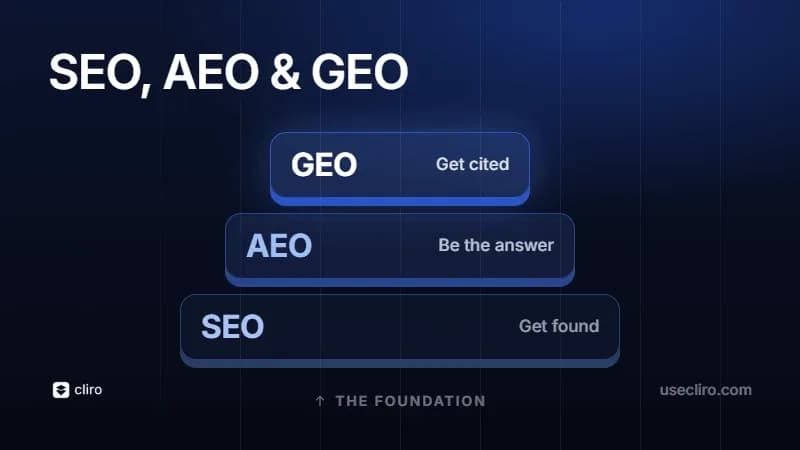
SEO, AEO and GEO: what they are and how they differ
SEO, AEO and GEO aren't the same, nor do they replace each other: they're three layers of one visibility strategy. We explain what each is and how they work together.