
What Is Share of Voice? Measuring AI Search Presence
Share of voice measures how often your brand appears versus competitors. Learn how it applies to AI search and how to measure your AI share of voice.


Share of voice (SOV) measures how much of the total conversation in a category belongs to your brand versus your competitors — and in AI search, it measures how often your brand appears in AI answers relative to the total brand mentions for that category. A high AI share of voice means that when people ask an AI about your space, you come up frequently compared with rivals. It turns scattered mention data into a single competitive position, which is why it has become a headline metric for AI visibility.
This guide explains what share of voice is, how AI share of voice differs from the traditional metric, how to calculate it, why it matters, the methodological caveats, and how to improve it.
What is share of voice, traditionally?
Share of voice originated in advertising and media, where it measured a brand's portion of total ad spend or media coverage in a category. The logic is comparative: not just how visible you are in absolute terms, but how visible you are relative to everyone competing for the same attention. It later extended to organic search and social listening, always answering the same question — of all the relevant conversation, how much is about us?
How is AI share of voice different?
AI share of voice applies that comparative logic to AI-generated answers. Instead of ad spend or search rankings, the raw material is brand mentions inside AI responses across many prompts in your category. Your AI SOV is your share of those mentions relative to all brands mentioned. The difference from traditional SOV is the medium and its variability: AI answers differ by engine, prompt and time, so AI SOV must be built from a broad, repeated sample of prompts across multiple engines rather than a single measurement.
How do you calculate AI share of voice?
At its simplest, AI share of voice is a ratio:
AI Share of Voice = (your brand mentions) / (total brand mentions in the category) × 100
To make it meaningful, the mentions are aggregated across a representative set of category prompts and across the engines you care about. More sophisticated versions weight the count — for example, giving more credit to prominent, early mentions than to passing ones, or to cited mentions over uncited ones — so the metric reflects quality of presence, not just raw frequency. The core idea stays the same: your presence as a proportion of the whole category's presence.
Why does share of voice matter?
Share of voice matters because visibility is competitive, not absolute. Being mentioned in AI answers is good; being mentioned more than your competitors is what wins consideration. SOV captures that relative standing in one figure, making it easy to see whether you're the default reference in your category or an also-ran, and to track whether you're gaining or losing ground as the AI landscape shifts. It reframes AI visibility from "are we present?" to "are we winning the category?"
What are the methodological caveats?
A few cautions keep AI SOV honest. The prompt set must be representative and neutral, since the questions you choose shape the result. The sample must be large and repeated, because single answers are noisy and vary over time. The category definition matters — who counts as a competitor changes the denominator. And raw mention counts can mislead if they ignore prominence and sentiment, so a brand with many negative or passing mentions may have high SOV but weak real standing. Treat AI SOV as a rigorously-sampled estimate, not an exact constant.
How do you improve share of voice?
Improving AI SOV is relative work: you gain share by being mentioned where you currently aren't, and more prominently where you already are, while competitors hold steady. That means finding the category prompts where rivals dominate and you're absent, understanding the authoritative sources the engines cite there, and strengthening your content, structure and web presence to become a citable option for those prompts. Because SOV is a proportion, displacing a competitor's mention improves your share twice over. [Editor: Cliro tie-in — AI Share of Voice is the product's core metric and proprietary data moat; link and add a data point.]
Share of voice checklist
- Define a neutral, representative prompt set for your category.
- Aggregate mentions across many prompts and engines.
- Compute your share of total category mentions.
- Weight by prominence and citation where possible, not just raw count.
- Benchmark against competitors and track over time.
- Target prompts where rivals dominate to gain share.
Frequently asked questions
What is share of voice?
Share of voice measures how much of the total conversation in a category belongs to your brand versus competitors. In AI search, it measures how often your brand appears in AI answers relative to all brand mentions for that category.
How do you calculate AI share of voice?
Divide your brand's mentions by the total brand mentions in the category and multiply by 100, aggregated across a representative set of prompts and engines. Advanced versions weight mentions by prominence or citation.
Why does share of voice matter?
Because visibility is competitive. Being mentioned is good, but being mentioned more than competitors wins consideration. SOV captures relative standing in one figure and shows whether you're gaining or losing ground.
How is AI share of voice different from traditional SOV?
It applies the same comparative logic to AI-generated answers, using brand mentions inside AI responses. Because answers vary by engine, prompt and time, it must be built from a broad, repeated sample rather than a single measurement.
How do I improve my share of voice?
Find category prompts where competitors dominate and you're absent, understand the sources the engines cite there, and strengthen your content and web presence to become a citable option, since displacing a rival improves your share twice over.

Written by
Federico Ergang
Cliro cofounder & CEO
Federico Ergang is cofounder and CEO of Cliro, the AI visibility and GEO platform for Latin America.
Related articles

What Is AI Visibility? How Brands Appear in AI Search
AI visibility is how present your brand is in AI-generated answers. Learn what drives it, how to measure it, and why it's the new frontier of search.
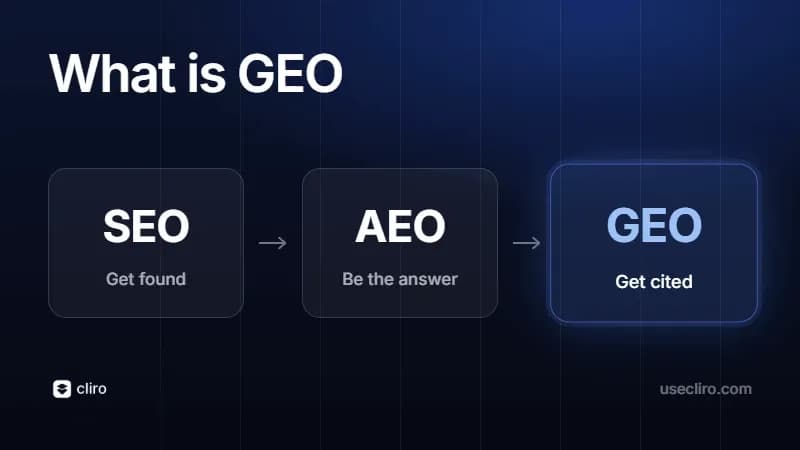
What is GEO (Generative Engine Optimization)? A complete guide
GEO (Generative Engine Optimization) means optimizing your brand to show up in answers from ChatGPT, Gemini and other AI. What it is, why it matters, how to do it and how to measure it.