
What Is Structured Data? Schema Markup for SEO and AI
Structured data (schema markup) labels your content so engines understand it and can show rich results. Learn the types, formats, and how it helps AI.


Structured data is a standardized code format you add to a page to label its content explicitly — telling search engines and AI systems what each part means, such as "this is an article," "this is a price," or "this is a FAQ." It is most commonly implemented with schema.org vocabulary in JSON-LD. By removing the guesswork about what content represents, structured data helps engines display rich results and helps machines understand the entities on your page — which matters more than ever as AI systems read the web.
This guide explains what structured data is, the schema.org vocabulary and JSON-LD format, the most useful types, how it enables rich results, whether it affects ranking, and why it matters for AI.
What is structured data, exactly?
Structured data is machine-readable markup that describes the meaning of content rather than just its appearance. Normal HTML tells a browser how to display text; structured data tells an engine what that text is. Marking up a recipe, for example, identifies the ingredients, cook time and rating as distinct, labeled fields. This explicit labeling lets engines parse a page with confidence instead of inferring meaning from layout and wording.
What are schema.org and JSON-LD?
Schema.org is the shared vocabulary that defines the available types and properties — Article, Product, FAQPage, Organization and hundreds more — and it is supported across major search engines. JSON-LD is the recommended format for adding it: a block of JavaScript Object Notation placed in the page's code that describes the content without being tangled into the visible HTML. Older formats, microdata and RDFa, embed the labels directly in HTML tags, but JSON-LD is preferred today because it's cleaner to maintain and keeps markup separate from presentation.
What are the most useful schema types?
| Type | Labels | Common use |
|---|---|---|
| Article / BlogPosting | Headline, author, date | Blog posts and news |
| FAQPage | Question-and-answer pairs | FAQ sections |
| HowTo | Steps in a process | Tutorials and guides |
| Product | Price, availability, rating | E-commerce pages |
| Organization | Brand name, logo, profiles | Identity and knowledge panels |
| BreadcrumbList | Page hierarchy | Navigation context |
How does structured data enable rich results?
Rich results are the enhanced listings search engines show when they trust a page's markup — star ratings, FAQ dropdowns, recipe cards, breadcrumb trails and more. Structured data is what makes a page eligible for them. Eligibility is not a guarantee; the engine decides whether to display the enhancement. But without the markup, the page can't qualify at all. Rich results occupy more space and stand out, which can improve click-through even when overall ranking is unchanged.
Is structured data a ranking factor?
Not a direct one. Search engines have said structured data is not itself a ranking signal that lifts your position. Its value is indirect but real: it makes pages eligible for rich results and helps engines understand content accurately, both of which can improve visibility and click-through. So the right expectation is that structured data clarifies and enhances how your page is presented and understood, rather than directly pushing it up the rankings.
Why does structured data matter for AI?
Structured data is especially valuable for AI systems because it states facts in a form machines parse unambiguously. When an engine needs to know your organization's name, an article's author, or the answer to a specific question, labeled data removes interpretation errors. For AI answer engines deciding what a page says and whether to cite it, clearly-labeled entities and FAQ pairs are easier to extract and trust than meaning inferred from prose alone. Structured data won't replace good content, but it reinforces machine understanding of that content — which supports both classic rich results and AI citation. [Editor: optional Cliro tie-in on schema as a foundation for being understood by AI engines.]
How do you implement and test structured data?
The practical workflow is straightforward: add a JSON-LD block describing the page's main entity, make sure the marked-up values exactly match what's visible on the page, then validate. Google's Rich Results Test and the Schema Markup Validator check for errors and show eligibility. Many CMS platforms and SEO plugins generate common schema automatically; the job is to confirm it's accurate and complete rather than hand-coding everything.
What are the common mistakes?
The most damaging error is marking up content that doesn't appear on the page, or values that don't match the visible content — engines treat this as misleading and may ignore the markup or apply a penalty. Other frequent issues are using the wrong type, leaving required properties missing, and marking up content that isn't actually present. The rule of thumb: structured data should describe what's truly on the page, accurately and completely.
Structured data checklist
- Use JSON-LD with schema.org vocabulary.
- Mark up your main entities (Article, FAQPage, Product, Organization as relevant).
- Match markup to visible content exactly.
- Validate with the Rich Results Test and Schema validator.
- Add FAQPage schema to genuine FAQ sections.
- Keep it accurate — never mark up content that isn't on the page.
Frequently asked questions
What is structured data?
Structured data is standardized markup that labels a page's content explicitly, telling search engines and AI systems what each part means. It is usually implemented with schema.org vocabulary in JSON-LD format.
What is the difference between schema.org and JSON-LD?
Schema.org is the shared vocabulary of types and properties; JSON-LD is the recommended code format for adding that vocabulary to a page without embedding it in the visible HTML.
Is structured data a ranking factor?
Not directly. It does not itself lift rankings, but it makes pages eligible for rich results and helps engines understand content accurately, which can improve visibility and click-through.
What schema types should I use?
Common high-value types include Article or BlogPosting, FAQPage, HowTo, Product, Organization and BreadcrumbList. Choose the type that matches your page's main content.
How does structured data help AI?
It states facts in a machine-parseable form, removing interpretation errors. Clearly labeled entities and question-answer pairs are easier for AI engines to extract and trust, supporting both rich results and AI citation.

Written by
Federico Ergang
Cliro cofounder & CEO
Federico Ergang is cofounder and CEO of Cliro, the AI visibility and GEO platform for Latin America.
Related articles
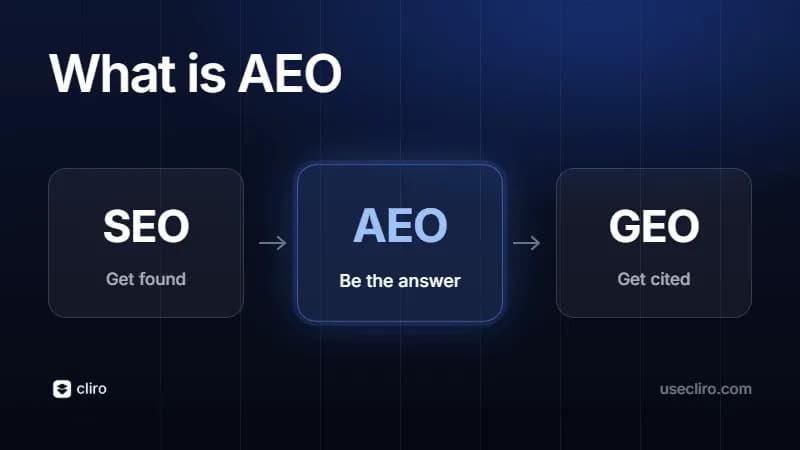
What is AEO (Answer Engine Optimization): a complete guide
AEO (Answer Engine Optimization) is optimizing your content to be the direct answer in AI Overviews, ChatGPT and voice search. What it is and how to do it.
What Is Question-Answer Format? Content Built for AI
Question-answer format structures content as questions with clear, brief answers — ideal for AI and assistants to reuse. Learn how and when to use it.
What Is a Featured Snippet? How to Win Position Zero
A featured snippet is the answer box Google shows above the results. Learn the types, how to win one, and how snippets connect to AI Overviews.