
What is llms.txt and how to create yours
What the llms.txt file is, how to create yours step by step and the truth about its adoption: why it's a low-cost, low-yield bet right now.


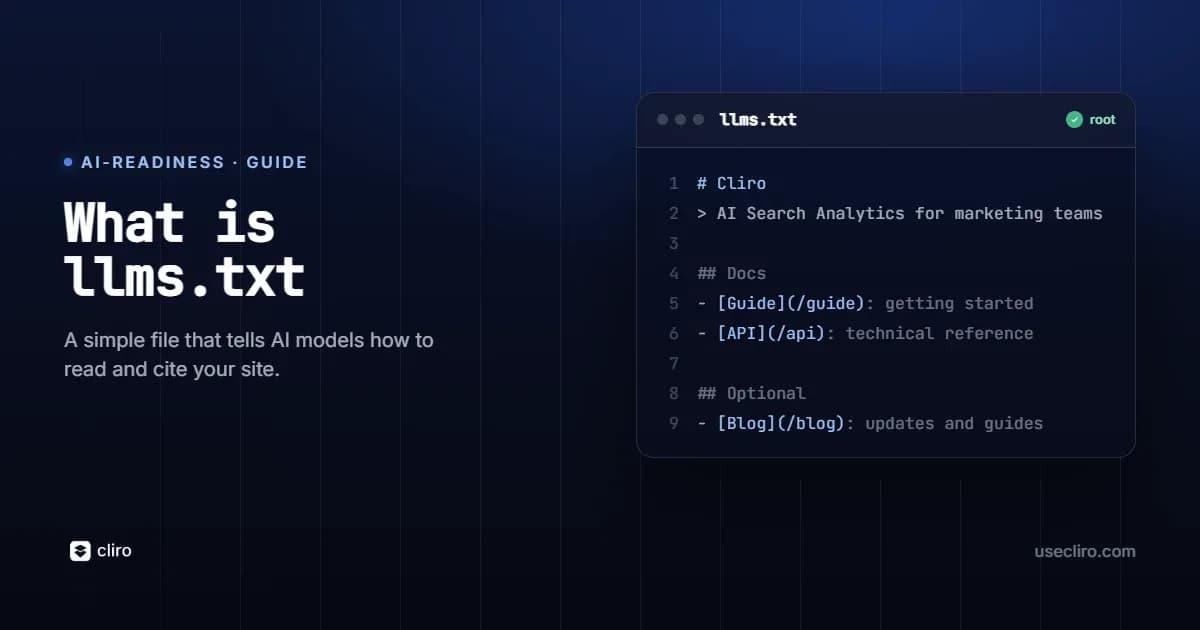
If you've researched GEO, you've surely come across llms.txt and the promise that it's "the key to appearing in AI." The reality is more nuanced: it's an easy file to create, but its real effect today is up for debate. We'll tell you what it is, how to create it and, above all, what to actually expect.
llms.txt is a text file (in Markdown) that you place at the root of your domain (yourdomain.com/llms.txt) to give LLMs a curated guide to your most important content. It's a community convention, not an official standard, and as of today no major AI provider has confirmed using it to cite or rank: studies show no visibility improvement. Honest takeaway: it's a low-cost, low-yield bet. Create it if it's free or nearly so, but don't expect magic.
What is llms.txt?
It's a September 2024 proposal, from Jeremy Howard, to help models understand your site. The idea: instead of making AI fight through your HTML full of navigation, scripts and ads, you offer it a clean Markdown file that points to your key content with one-line descriptions.
What it looks like
It's simple Markdown:
- A title (H1) with the site or brand name.
- A short summary, in blockquote form, of what it is.
- Sections with links to your most important pages, each with a one-line description.
Companies like Anthropic, Stripe or Supabase publish one, mostly for their documentation.
llms.txt is not robots.txt
This is the most common mistake. robots.txt controls access: what bots can crawl. llms.txt doesn't block anything; it's a content guide that says "this is what matters on my site." If what you want is to control AI crawlers, that's done in robots.txt, not here.
The truth about its adoption
Here it's worth being blunt, because there's a lot of hype:
- It's a community convention (not W3C or IETF) and has no enforcement mechanism.
- According to an SE Ranking study of 300,000 domains, around 10% of sites have it.
- As of Q1 2026, no major provider (OpenAI, Google, Anthropic, Meta, Mistral) has publicly confirmed reading or acting on it in production. GPTBot fetches it occasionally, but that doesn't mean it influences citations.
- Google clarified, via John Mueller, that its Search doesn't use or endorse it; it appeared on Google sites due to a CMS update, not as a signal.
- Citation studies show no measurable improvement from having it.
Is it worth creating?
Yes, if it's cheap. It's a low-cost, low-yield bet: it won't give you a jump in visibility, but it won't hurt you either, and it has some optionality if adoption grows. Where it does have real value today is for documentation and agents: serving clean Markdown greatly reduces the noise and tokens for the systems that do consume it. If your site can auto-generate it from the sitemap, do it; if it's a big project, it's not a priority.
How to create yours, step by step
- Create a text file and publish it at yourdomain.com/llms.txt.
- At the top, an H1 with your brand name and a one- or two-sentence summary in blockquote form.
- List your key pages by section, each link with a one-line description. Curated, not everything: don't include every blog post.
- Keep it under about 200,000 tokens so a model can process it in one shot.
- Security: don't make it publicly editable. A tamperable llms.txt is a prompt-injection vector; treat it with the same care as your robots.txt.
Common mistakes
- Thinking it blocks or controls access (that's robots.txt).
- Copying every page of the site as Markdown: unnecessary and it clutters the file.
- Expecting a visibility jump: there's no evidence.
- Leaving it publicly editable: a security risk.
Frequently asked questions
Does it help me appear more in ChatGPT?
There's no evidence it improves citations today; it's low-impact.
Is it the same as robots.txt?
No. robots.txt controls access; llms.txt is a content guide.
Do LLMs use it?
No major provider has confirmed using it in production; some bots fetch it occasionally.
So why create it?
For its low cost and optionality, and because it's useful for documentation and agents that do consume it.
Can it hurt me?
No, unless you leave it editable and allow a prompt injection.

Written by
Federico Ergang
Cliro cofounder & CEO
Federico Ergang is cofounder and CEO of Cliro, the AI visibility and GEO platform for Latin America.
Related articles
robots.txt for AI crawlers: GPTBot, ClaudeBot and more
Which AI crawlers exist, which to let in and how to set up your robots.txt so AI can cite you. With ready-to-copy templates.
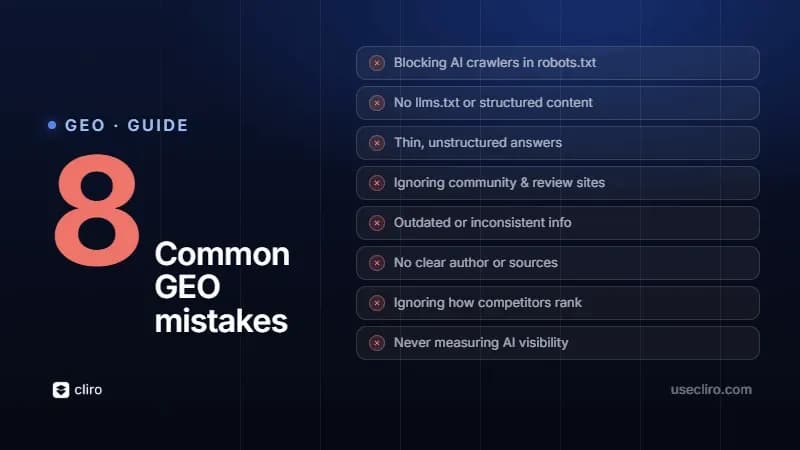
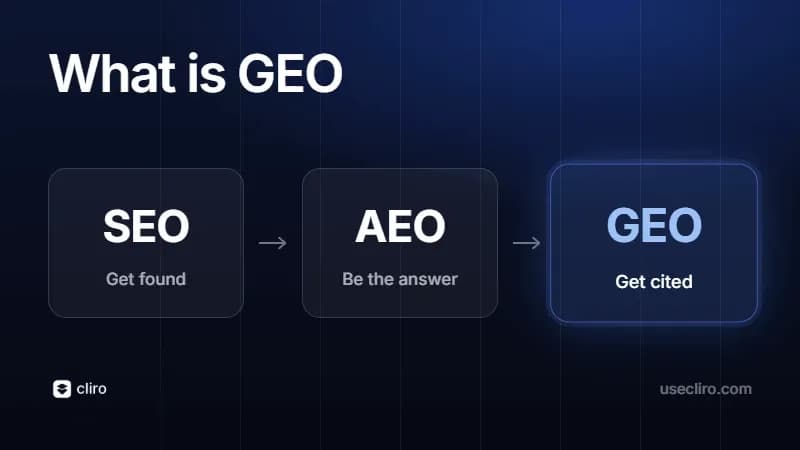
What is GEO (Generative Engine Optimization)? A complete guide
GEO (Generative Engine Optimization) means optimizing your brand to show up in answers from ChatGPT, Gemini and other AI. What it is, why it matters, how to do it and how to measure it.