
AI Citation Analysis: How to Measure Where LLMs Cite You
AI citation analysis measures where, how often, and how prominently LLMs cite your brand across AI engines, then turns that into action. The metrics that matter, how to run it, and the mistakes that make the data useless.


AI citation analysis is the practice of measuring where, how often, and how prominently large language models cite your brand as a source across AI engines, and then using that data to improve it. It isn't rank tracking: there's no fixed position to hold, so the unit of measurement is citation share across a set of prompts, models, and time, not a single ranking.
If you've confirmed your brand can appear in ChatGPT, citation analysis is the next question: not just whether you show up, but how you show up relative to competitors, on which engines, and whether that's improving. This guide covers the metrics that matter, how to run the analysis, and the mistakes that make the numbers meaningless.
What is AI citation analysis?
It's the measurement layer of AI visibility. When an AI engine answers a question and cites sources, citation analysis records which brands and URLs were cited, in what position, with what framing, and how that distribution shifts across engines and over time. The output isn't a keyword ranking, it's a competitive picture of who the models treat as authoritative in your category. For the underlying concept, see what citations in AI search are.
How is it different from SEO rank tracking?
Four structural differences change everything about how you measure:
- It's non-deterministic. The same prompt run several times can cite different sources each time. A single check is noise; you need repeated runs over a fixed period to get a stable rate.
- There's no shared SERP. Each engine retrieves and cites differently. One 2026 analysis found only about 11% citation overlap between platforms, so a single-platform view is misleading by design.
- Mention is not citation. Being named in the answer text (a mention) is different from being linked as a source (a citation), and only citations send referral traffic. Measure them separately, see mention vs. citation.
- Position is probabilistic prominence, not a rank. A source cited in the first third of an answer is far more likely to be seen than one in the tail, so where you're cited matters as much as whether you're cited.
Which metrics actually matter?
The market is fragmented: tools report a “42% citation rate” or “0.73 share of voice” with no comparable basis, so definitions matter more than headline numbers. These are the metrics worth tracking, and how each is calculated:
| Metric | What it answers | How it's calculated |
|---|---|---|
| Citation Rate | How often you're cited at all | Cited prompts ÷ total prompts, per engine, over a fixed window |
| Citation Share of Voice | Your slice versus competitors | (Your citations ÷ all tracked brands' citations) × 100 |
| Average Citation Position | How prominently you're cited | Placement on a 3-tier scale: top (first 30% of answer), middle, tail |
| Top / First-Citation Rate | How often you're the lead source | Top-tier citations ÷ total citations |
| Cross-Model Coverage | Breadth across engines | Engines citing you ÷ engines tracked (expect low overlap between them) |
| Source Concentration (HHI) | Whether your visibility is fragile | Herfindahl index across the domains cited alongside you in your category |
| Mention-to-Citation Gap | Named but not linked | Mentions − citations (a large gap means lost traffic) |
| Sentiment | How the model frames you | Share of negative / neutral / positive context around your mention |
| Velocity | Whether you're gaining or losing ground | Change in citation rate or SoV period over period |
Citation Share of Voice is usually the headline metric because it's competitive and comparable; the rest explain why it moves. For share of voice specifically, see what share of voice is.
How do you actually run a citation analysis?
- Build a prompt library of opening questions. Citations concentrate on the first question of a research journey (“best [category] tools”, “how to choose a [solution]”), not follow-ups. Twenty-five well-chosen opening prompts beat a hundred clarifying ones.
- Run each prompt across engines. ChatGPT, Gemini, Claude, Perplexity and Grok cite differently; track them separately, not as an average.
- Repeat over a fixed window. Because results are non-deterministic, run each prompt multiple times over, say, a 7-day period and aggregate, rather than reading a single response.
- Log the details, not just presence. For every appearance, record whether it was a mention or a citation, which URL was cited, the position tier, and the sentiment.
- Add a competitive layer. Tally the same prompts for your competitors to compute Share of Voice and to see which engines favor which brands.
- Map your citation neighbors. Note which trusted domains you co-appear with; those are the sources to earn presence in next.
What do platform citation patterns tell you?
Each engine has a source personality, and it tells you where to invest. A Profound analysis of roughly 680 million citations found ChatGPT leans heavily on Wikipedia (nearly half of its citations) with Reddit and Forbes behind it, while Google AI Overviews and Perplexity lean far more on Reddit and YouTube. LinkedIn also surged to become a top-cited domain for professional queries between late 2025 and early 2026. The practical read: if your target engine is ChatGPT, Wikipedia hygiene and encyclopedic-grade sources matter; if it's Perplexity or AI Overviews, community and video presence carry more weight. For more, see what kinds of sources LLMs cite most.
How does citation analysis connect to traffic?
Citations are the leading indicator; referral traffic is the lagging one. A high citation rate with a large mention-to-citation gap means you're influencing answers without earning clicks. To close the loop, pair citation analysis with AI referral measurement, see how to measure ChatGPT traffic in GA4. Tracking both lets you correlate which citation patterns actually convert into visits.
Common mistakes
- Judging visibility from a single run instead of aggregating repeated runs.
- Tracking one engine and assuming the others behave the same.
- Counting mentions as citations, or vice versa.
- Tracking clarifying follow-ups instead of the opening questions where citations concentrate.
- Reporting a citation rate with no competitive Share-of-Voice context.
- Ignoring position and sentiment, being cited negatively in the tail isn't the same as leading the answer.
Frequently asked questions
What's the difference between a citation and a mention?
A mention names your brand in the answer text; a citation links your page as an attributed source. Only citations drive referral traffic, so they're measured separately.
How many prompts do I need to track?
Enough opening questions to represent how real buyers start researching your category, run repeatedly across engines. Quality and repetition matter more than raw prompt count.
Why do my results change every time I check?
LLM answers are non-deterministic. That's why citation analysis relies on aggregated rates over a fixed window, not one-off checks.
Is Share of Voice the most important metric?
It's the best headline because it's competitive and comparable, but position, sentiment, and the mention-to-citation gap explain why it moves and what to fix.
Do all AI engines cite the same sources?
No. Citation overlap between platforms is low (around 11% in one 2026 study), and each engine favors different source types, which is why cross-model coverage is its own metric.

Written by
Federico Ergang
Cliro cofounder & CEO
Federico Ergang is cofounder and CEO of Cliro, the AI visibility and GEO platform for Latin America.
Related articles
What Are Citations in AI Search? The Sources Behind Answers
Citations are the sources an AI engine links to support its answer. Learn how AI citations work, why they matter, and how to earn more of them.
Mention vs. Citation in AI Search: The Difference
In AI search, a mention names your brand while a citation links to your source. Learn the difference between them and why both matter for AI visibility.
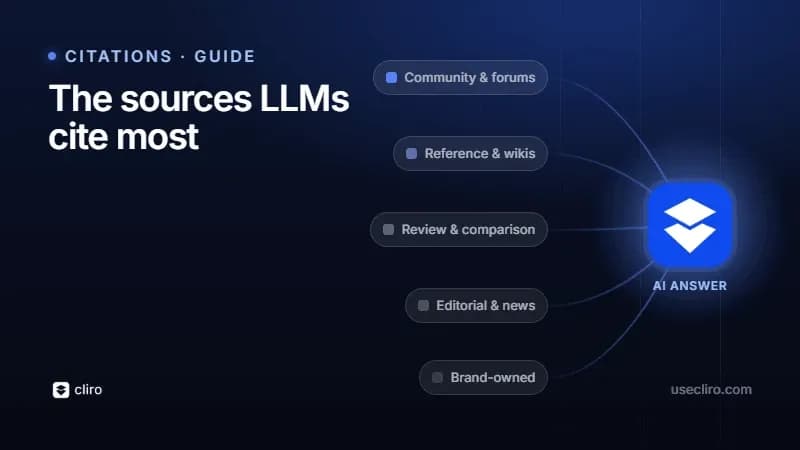
What kinds of sources do LLMs cite most?
What kinds of sources ChatGPT, Gemini and Perplexity cite most, according to the studies: why Reddit, Wikipedia and YouTube dominate, and what to do about it.