What Is Citable Content? Writing to Be Cited by AI
Citable content is content AI engines can easily extract and cite. Learn its characteristics and how to write content built to be referenced in AI answers.


Citable content — also called extractable content — is content written so that an AI engine can easily lift a clear, self-contained, accurate passage from it and cite it as a source in an answer. It's the practical destination of everything answer-engine and generative-engine optimization aim for: not just being crawled, but being the passage an engine chooses to extract and credit. As AI answers replace lists of links, writing citable content is how a brand earns the references that drive authority and traffic in AI search.
This guide explains what citable content is, why engines cite what they can extract, the characteristics of citable content, how it synthesizes AEO and GEO, and how to audit your own pages for it.
Why do engines cite what they can extract?
AI answers are built by retrieving passages and synthesizing them, so an engine can only cite what it can cleanly pull out and trust. A passage that states a complete, accurate point on its own is easy to lift and attribute; a point buried in a long, context-dependent paragraph is hard to extract without distortion, so the engine skips it or paraphrases it without credit. Extractability, in other words, is a precondition for citation. The more your key points stand alone as clean, verifiable statements, the more candidates you give an engine to cite.
What are the characteristics of citable content?
| Characteristic | Why it earns citations |
|---|---|
| Self-contained | Each passage makes sense alone, so it survives extraction |
| Answer-first | The key point leads, so the answer is easy to find and lift |
| Structured | Clear headings, lists and tables make passages easy to parse |
| Factual and verifiable | Specific, accurate claims are safe for an engine to cite |
| Well-formatted | Clean HTML and schema make meaning explicit to machines |
| Authoritative | Clear expertise makes you a source worth crediting |
None of these is exotic — they're the same habits that produce good featured snippets and clear writing. Citable content simply applies them deliberately, so every important point is a clean, standalone, trustworthy unit an engine can reuse.
How does citable content synthesize AEO and GEO?
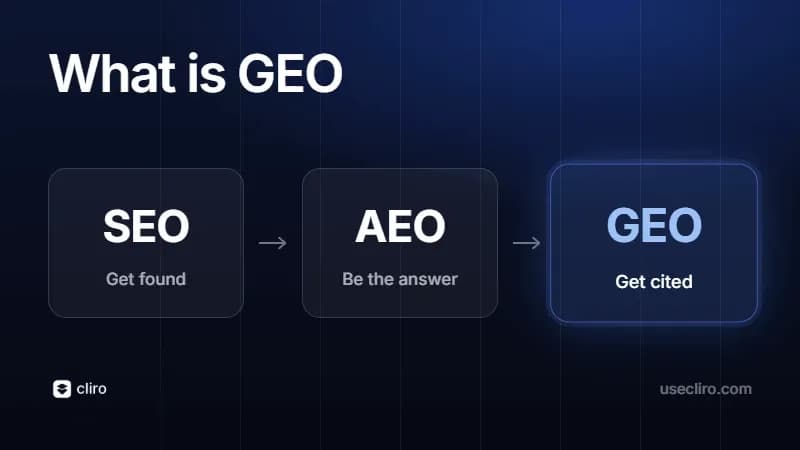
Citable content is where answer-engine optimization and generative-engine optimization converge. AEO pushes you to structure content as direct, self-contained answers to real questions; GEO pushes you to be a retrievable, authoritative source that generative engines reach for. Citable content is the artifact that satisfies both at once: a page made of clean, answer-first, well-structured, verifiable passages is simultaneously snippet-ready and citation-ready. In that sense, "write citable content" is the single instruction that captures most of what AEO and GEO ask for.
How does it connect to retrieval and RAG?
Citable content maps directly onto how retrieval-augmented systems work. Those systems split content into chunks, embed them, and retrieve the chunks that best match a query before generating an answer. A self-contained, answer-first passage forms a clean chunk with a clear meaning, so it's retrieved accurately and used faithfully — and then cited. A rambling, context-dependent passage forms a muddy chunk that's retrieved poorly and reused loosely, if at all. Writing citable content is, quite literally, optimizing your pages for the retrieval step that decides what gets cited. [Editor: Cliro tie-in — measuring which content earns citations and where the gaps are is the heart of the product; strong CTA here.]
How do you audit content for citability?
Auditing for citability means reading your pages the way an engine extracts them. For each key point, ask: could this passage be lifted out and still make complete sense? Does the answer come first, or is it buried? Is the claim specific and verifiable, or vague? Are headings, lists and tables doing the structural work? Is the page crawlable and cleanly formatted? Where a passage fails these tests, rewrite it to stand alone, lead with the answer, and state the fact precisely. Then track the outcome — which pages and passages actually get cited across AI engines — and feed that back into your content.
Citable content checklist
- Make every key point self-contained, so it survives extraction.
- Lead with the answer, then elaborate.
- Structure with headings, lists and tables.
- State specific, verifiable facts an engine can safely cite.
- Format cleanly with accessible HTML and structured data.
- Demonstrate authority, and track which content gets cited.
Frequently asked questions
What is citable content?
Citable (extractable) content is content written so an AI engine can easily lift a clear, self-contained, accurate passage and cite it as a source. It's the practical goal of answer-engine and generative-engine optimization.
Why do AI engines cite content they can extract?
Because AI answers are built by retrieving and synthesizing passages, an engine can only cite what it can cleanly pull out and trust. Self-contained, accurate passages are easy to lift and attribute; buried points get skipped or used without credit.
What makes content citable?
Being self-contained, answer-first, well-structured with headings and tables, factual and verifiable, cleanly formatted with schema, and authoritative. These are deliberate applications of clear-writing habits.
How does citable content relate to AEO and GEO?
It's where they converge. AEO structures content as direct, self-contained answers; GEO makes you a retrievable, authoritative source. Citable content satisfies both — clean, answer-first, verifiable passages are both snippet-ready and citation-ready.
How do I make my content more citable?
Audit each key point by asking whether it could be lifted out and still make sense, whether the answer comes first, and whether the claim is specific and verifiable. Rewrite passages to stand alone, lead with the answer, format cleanly, and track which content gets cited.

Written by
Federico Ergang
Cliro cofounder & CEO
Federico Ergang is cofounder and CEO of Cliro, the AI visibility and GEO platform for Latin America.
Related articles
What Is Self-Contained Content? Writing for AI Citation
Self-contained content is text that stands on its own, so AI can extract it without losing meaning. Learn the principles and how to write it for AEO.
What Are Citations in AI Search? The Sources Behind Answers
Citations are the sources an AI engine links to support its answer. Learn how AI citations work, why they matter, and how to earn more of them.
What is GEO (Generative Engine Optimization)? A complete guide
GEO (Generative Engine Optimization) means optimizing your brand to show up in answers from ChatGPT, Gemini and other AI. What it is, why it matters, how to do it and how to measure it.