
SEO, AEO and GEO: what they are and how they differ
SEO, AEO and GEO aren't the same, nor do they replace each other: they're three layers of one visibility strategy. We explain what each is and how they work together.


Search is no longer a list of blue links. Today, a large share of decisions starts —and often ends— inside an AI-generated answer in ChatGPT, Gemini, Claude or Perplexity. That shift brought new acronyms: on top of the SEO you already know, people now talk about AEO and GEO. The logical question is whether they're the same, whether they compete, or whether one replaces the other.
The short answer: they're three layers of the same visibility system, and they depend on each other.
One line each:
- SEO (Search Engine Optimization): getting search engines to find, index and rank your content.
- AEO (Answer Engine Optimization): getting your content to be the direct answer that's extracted and shown.
- GEO (Generative Engine Optimization): getting AI models to mention, cite and reuse your brand when they answer.
What is SEO?
SEO optimizes your site for traditional search engines: so they can crawl, index and rank your pages. Its unit of success is the position in the results and the click that follows.
It's still the foundation of everything. If a search engine —or an AI crawler— can't access your site or understand its content, nothing downstream happens. In the language of the three layers, SEO enables retrieval (your content being found and read).
What is AEO?
AEO optimizes so your content becomes the answer, not one link among ten. It shows up in featured snippets, voice search, Google's AI Overviews and the passages an assistant extracts to answer a question.
Its unit of success is no longer position but extraction: the system taking your fragment as the answer. That depends on content structure —direct answers up front, question-style headings, data in tables, FAQ sections—. AEO enables extraction.
What is GEO?
GEO optimizes so generative models (ChatGPT, Gemini, Claude, Perplexity, Grok) mention, cite and reuse you when they build their answers. Unlike a search engine, the model doesn't return a list: it synthesizes an answer from the sources it "trusts".
That's why the unit of success is inclusion: appearing within that synthesis, ideally cited, and repeatedly. It depends on signals different from classic SEO: entity authority, third-party mentions, citable first-party data and brand consistency. GEO enables trust and reuse.
An honest note on terminology. In the industry, AEO and GEO are sometimes used as synonyms, and there's real overlap. The useful distinction is this: AEO focuses on being the answer extracted by an answer engine (including AI Overviews), while GEO focuses on being cited and reused inside generative answers. In practice they coexist, and most brands need both.
SEO, AEO and GEO, compared
Each layer, by dimension:
- Goal — SEO: rank pages · AEO: be the answer · GEO: get cited by AI
- Where it happens — SEO: Google, Bing (links) · AEO: snippets, AI Overviews, voice · GEO: ChatGPT, Gemini, Claude, Perplexity
- Unit of success — SEO: position + click · AEO: extraction of the fragment · GEO: mention + citation + reuse
- What drives it — SEO: content + technical base (crawl/index) · AEO: structure, direct answers, schema · GEO: entity authority, citable data, mentions
- Key metric — SEO: ranking, organic traffic · AEO: appearance in snippets/Overviews · GEO: AI share of voice, citations
- Role in the system — SEO: retrieval · AEO: extraction · GEO: trust and reuse
Does GEO replace SEO?
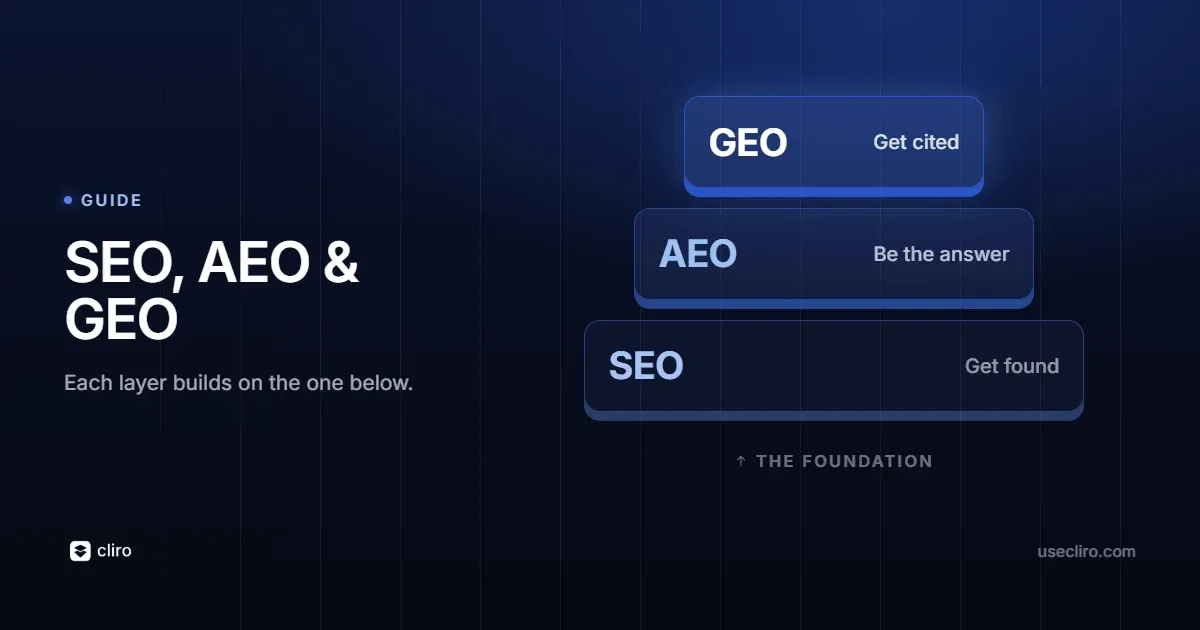
No. They're layers, not replacements, and they stack in this order: if a crawler can't reach your page (SEO), it can't extract a fragment from it (AEO), and AI has no basis to cite it (GEO). Each layer depends on the one below.
Put another way: SEO doesn't disappear with AI —it becomes the prerequisite.
How do they work together?
Think of them as a visibility funnel:
- SEO gets you found and understood.
- AEO makes your content extractable as an answer.
- GEO gets that answer included and cited, again and again, inside AI.
The key point: a single well-built page can serve all three layers if it's well structured. You don't need separate content for each; you need content that meets all three conditions at once.
Where to start?
- Lock down the technical base (SEO): make sure your content renders in the HTML, that AI crawlers are allowed in
robots.txt, and publish anllms.txt. - Structure for AEO: a direct answer at the top of each section, question-style headings, tables for comparable data, and an FAQ block with its schema.
- Build GEO: publish citable first-party data, honest comparisons of your category, and work on your presence in third-party listings and directories where AI goes to look.
How do you measure each layer?
You can't optimize what you don't measure. SEO has mature tools (rankings, traffic). AEO and GEO are newer: to know whether you're winning, you need to monitor whether AI actually mentions and cites you, across which models, in which prompts, and from which sources it builds its answers.
That's exactly the problem an AI visibility platform like Cliro solves: measuring your visibility, your share of voice against competitors, the citations and the sources AI uses to talk about your brand —across ChatGPT, Gemini, Claude, Perplexity and Grok— from a single place.
Frequently asked questions
Are AEO and GEO the same? Not exactly. AEO aims to make your content the extracted answer (snippets, AI Overviews); GEO aims to make your brand cited and reused inside generative answers. There's overlap, and many brands work on both at once.
Does SEO still matter in the age of AI? Yes. SEO is the prerequisite: if search engines and AI crawlers can't find and understand your content, there's no AEO or GEO to speak of.
What should a small brand prioritize? First the technical SEO base, then structuring content for AEO (low cost, high impact), and in parallel start building GEO signals with first-party data and mentions.
How do I know if my brand shows up in ChatGPT? By monitoring the prompts where you could appear and measuring how often AI mentions or recommends you. That's what an AI visibility platform measures.

Written by
Federico Ergang
Cliro cofounder & CEO
Federico Ergang is cofounder and CEO of Cliro, the AI visibility and GEO platform for Latin America.
Related articles

What is GEO (Generative Engine Optimization)? A complete guide
GEO (Generative Engine Optimization) means optimizing your brand to show up in answers from ChatGPT, Gemini and other AI. What it is, why it matters, how to do it and how to measure it.

What is AEO (Answer Engine Optimization): a complete guide
AEO (Answer Engine Optimization) is optimizing your content to be the direct answer in AI Overviews, ChatGPT and voice search. What it is and how to do it.

The best GEO tools in 2026
We compare the best GEO tools in 2026 —Cliro, Profound, Otterly, Peec AI and AthenaHQ— and which type of team each one is for.