
How to appear in Google AI Overviews and Gemini
How to get your brand to show up in Google's AI Overviews and Gemini: why SEO is the foundation, the role of Google-Extended and what content wins.


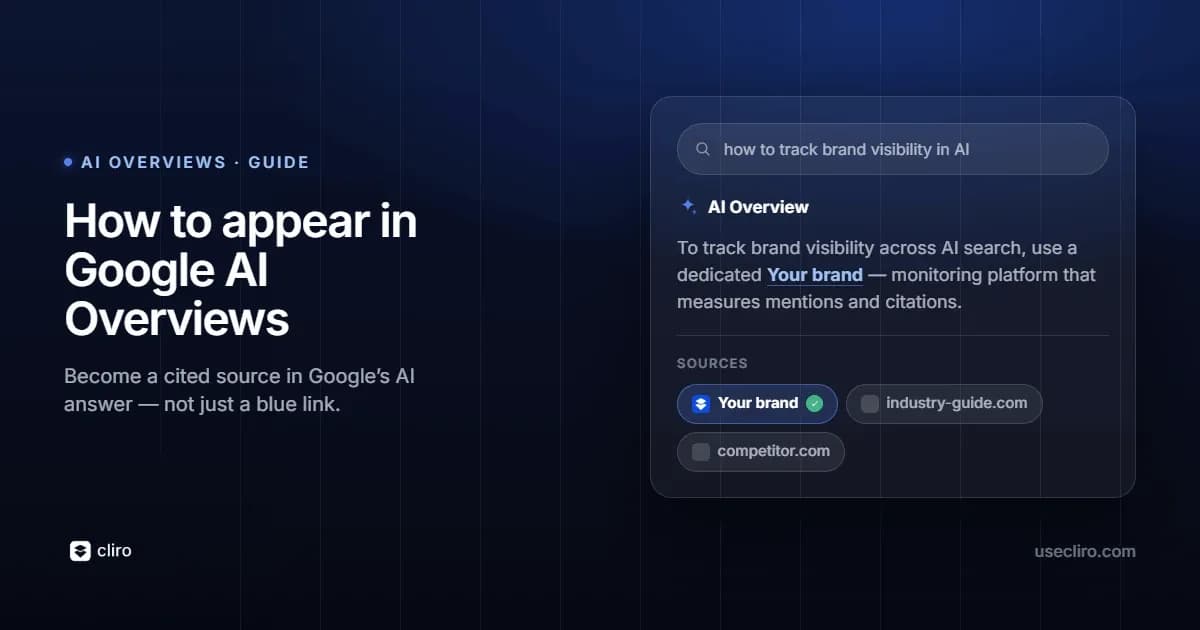
ChatGPT isn't the only one answering without people clicking. Google shows its AI Overviews above the results, and Gemini answers directly. Appearing there has its own rules, quite different from ChatGPT's, because they're tied to Google's ecosystem. This is the guide.
To appear in Google's AI Overviews you need, above all, to be indexed and rank well in traditional search: AI Overviews are built from Google's index, so solid SEO is the foundation. To appear in Gemini, you also need to allow the Google-Extended crawler in your robots.txt, because Gemini relies on Google Search (grounding) and doesn't use pages that block it. In both cases, clear, self-contained, trustworthy content wins.
How they differ from ChatGPT
ChatGPT relies on its training and its own web search. AI Overviews and Gemini, on the other hand, live inside Google's ecosystem: they feed on the search index and Google's infrastructure. So here your SEO matters far more than in ChatGPT.
Where they get their answers
AI Overviews are a Google Search feature: they build a summary from pages already in the index, citing and linking sources. Gemini (the assistant) uses grounding with Google Search: when it answers, it consults the web in real time through Google and cites sources. The practical consequence is direct: if you're not well-ranked and accessible in Google, it's hard for either to show you.
How to appear in Google AI Overviews
1. First, get indexed and rank
Your page has to be indexed and, ideally, rank well for the query. AI Overviews can cite beyond the top 10, but well-ranked pages have a much better chance. Without an SEO foundation, there's no AI Overview.
2. Make the answer clear and self-contained
Google favors pages where the main answer is immediate, clear and easy to verify. Use an "answer capsule" up top and headings that match the user's question.
3. Cover the topic in depth
Also answer the subtopics and related questions (check "People Also Ask" and Search Console queries). The more useful depth, the more valuable you are as a source.
4. Strengthen E-E-A-T and freshness
Work on experience, authority and trust signals, and keep content updated. Refreshing an old guide with new data can recover visibility.
5. Schema, internal linking and multimedia
Schema helps clarity and eligibility (it doesn't guarantee inclusion); internal linking helps Google understand your structure; and with AI Mode's visual search, images with good alt text help.
How to appear in Gemini
1. Allow Google-Extended
Gemini relies on Google Search for grounding, and Google doesn't use pages that block the Google-Extended token in robots.txt for grounding. If you block it, you're out of Gemini's citations. Important: allowing or blocking Google-Extended doesn't affect your ranking or your inclusion in Google Search; it only governs AI use.
2. The rest, same as AI Overviews
Clear, citable, authoritative, well-structured content. The foundation is the same as for AI Overviews.
The fine point: AI Overviews isn't the same as Gemini
Worth being clear: AI Overviews are part of Google Search and feed on the index (Googlebot), so blocking Google-Extended doesn't necessarily remove you from AI Overviews. Gemini, on the other hand, does depend on Google-Extended for grounding. In short: for AI Overviews, lead with SEO; for Gemini, also let Google-Extended through.
How to measure
For AI Overviews, Search Console shows you impressions and appearances. For Gemini and the other engines, since citations aren't easy to see, an AI visibility platform like Cliro shows you which answers you appear in and from which sources. For the general framework, read what GEO is.
Common mistakes
- Accidentally blocking Google-Extended and dropping out of Gemini.
- Thinking SEO doesn't matter: for AI Overviews it's the foundation.
- Burying the answer far from the start.
- Not updating content (freshness counts).
- Not measuring appearances.
Frequently asked questions
Does blocking Google-Extended lower my ranking?
No. Google clarified it doesn't affect search; it only affects AI use (Gemini and Vertex) and grounding.
Does SEO help with AI Overviews?
Yes, it's the foundation: your page must be indexed and ideally rank for the query.
Do I need schema?
It helps clarity and eligibility, but it doesn't guarantee inclusion in the AI Overview.
Is appearing in ChatGPT the same as in AI Overviews?
No. The rules differ: ChatGPT relies on its training and search; AI Overviews on Google's index.
How do I measure if I appear?
With Search Console for AI Overviews, and an AI visibility tool for Gemini and the rest.

Written by
Federico Ergang
Cliro cofounder & CEO
Federico Ergang is cofounder and CEO of Cliro, the AI visibility and GEO platform for Latin America.
Related articles
How to appear in ChatGPT: an optimization guide (GEO)
A practical GEO guide to getting ChatGPT to mention and cite your brand: how it retrieves and selects sources, why it cites only a fraction of what it reads, and the levers that actually move visibility.
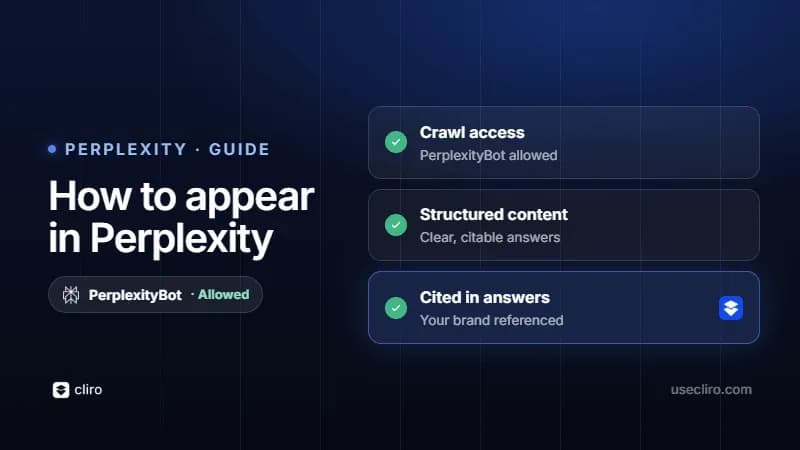
How to appear in Perplexity
Perplexity cites only a few sources per answer. How to make your brand one of them: crawlability, extractable content, freshness and authority.
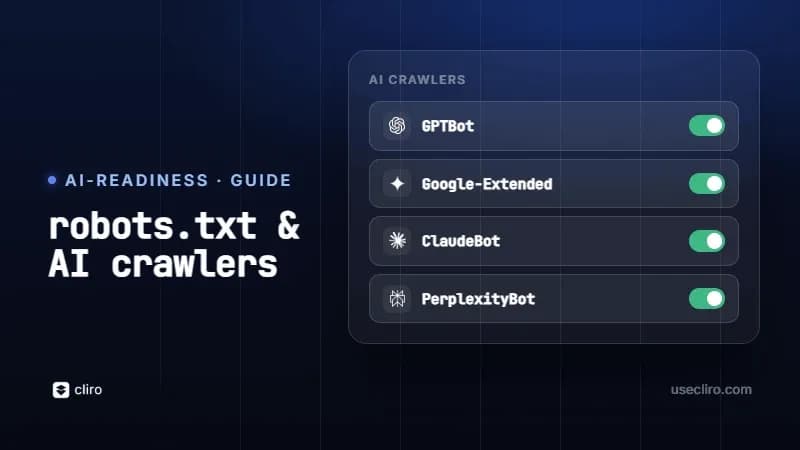
robots.txt for AI crawlers: GPTBot, ClaudeBot and more
Which AI crawlers exist, which to let in and how to set up your robots.txt so AI can cite you. With ready-to-copy templates.