
How to measure your brand's share of voice in AI
What share of voice in AI is and how to measure it: how often models mention you versus your competitors, how it's calculated and how to improve it.


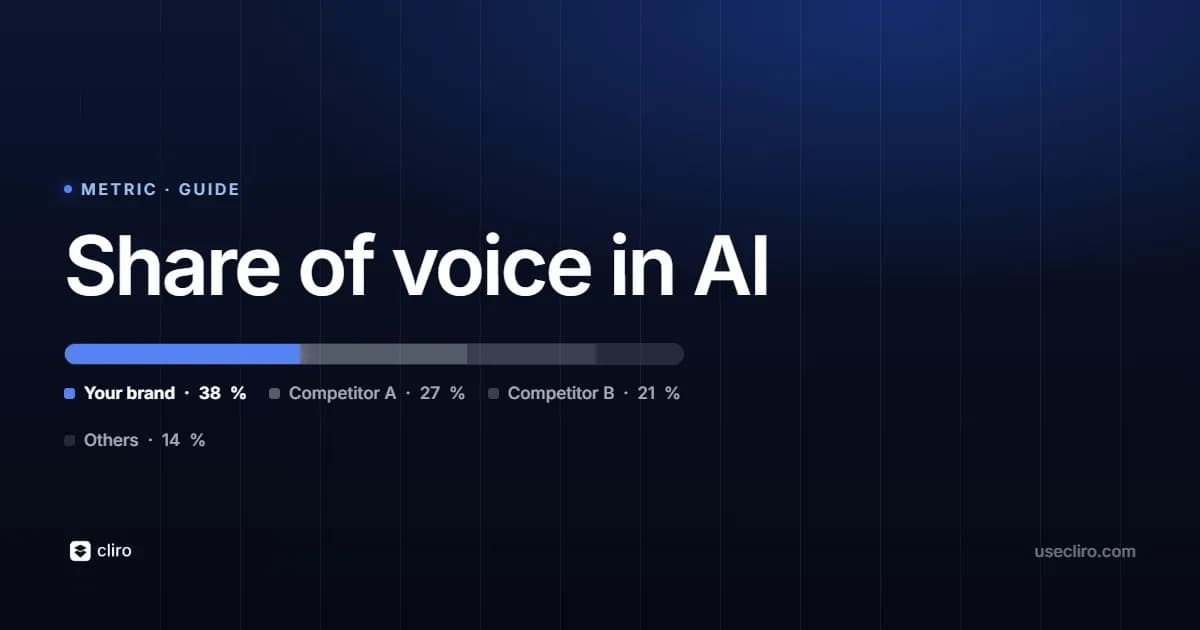
Appearing in ChatGPT is fine, but the question that matters for competing is a different one: how much do I appear compared to my competitors? That's the share-of-voice metric. If visibility tells you whether you exist for AI, share of voice tells you how much space you take up in your category.
Share of voice in AI is the percentage of AI answers about your category in which your brand appears, compared to your competitors. It's calculated over a set of representative prompts, repeated across several models: if the category totals 100 mentions and your brand appears in 30, your share of voice is 30%. It's the metric that shows who dominates the AI conversation in your market.
What is share of voice in AI?
It's the adaptation of a classic marketing metric —advertising share of voice— to the world of AI search. Instead of measuring how much space you take up in the media, it measures how much you take up in the answers of ChatGPT, Gemini, Claude, Perplexity and Grok when someone asks about your category.
Why it matters
Because visibility alone isn't enough to compete. You might appear in 40% of answers, but if your competitor appears in 70%, you're losing the category. Share of voice is relative: it places you against the others, which is what decides who gets the recommendation.
How it's calculated
In simple terms: your mentions divided by the total mentions in your category, over a set of prompts and several models. There are variants: by mentions (how many times you appear), weighted by position (appearing first counts more) or by model (your share can vary between ChatGPT and Perplexity). What matters is being consistent with the chosen method.
How to measure it, step by step
- Define your prompt set: the real questions in your category, without naming your brand.
- Define your competitor set: who you compare against.
- Run the prompts across several models (ChatGPT, Gemini, Claude, Perplexity, Grok).
- Repeat: answers vary, so you need several runs for a stable number.
- Count mentions: yours and each competitor's.
- Calculate your share and each competitor's.
- Track it over time: share of voice moves with every model update and with new content.
Share of voice vs visibility vs position
- Visibility: the percentage of answers you appear in (absolute, about you).
- Position: where in the answer you appear.
- Share of voice: your relative presence against competitors.
The three complement each other: visibility tells you whether you're there, position how prominent, and share of voice how much you dominate the category.
How to improve your share of voice
You improve your share by doing GEO: making sure AI can read you, citable content, presence in the sources it cites and original data. In practice, you gain share when you appear in more prompts and displace competitors within answers. For the how, see how to appear in ChatGPT and what GEO is.
By hand vs with a tool
By hand you can estimate your share with a few prompts, but it's tedious and unstable, because answers change. To measure it well you need many runs, several models and tracking over time. An AI visibility platform like Cliro calculates your share of voice automatically and compares it with your competitors. If you're not measuring anything yet, start by learning whether your brand appears in AI.
Common mistakes
- Measuring only your visibility and not comparing: you lose the competitive signal.
- Using few prompts or a single run: the number stays unstable.
- Measuring a single model.
- Naming your brand in the prompt: it biases the result.
- Not tracking it over time.
Frequently asked questions
What's a good share of voice?
It depends on your category and the number of competitors. What matters is the trend and your relative position, more than an absolute number.
Is it the same as visibility?
No. Visibility is absolute (about you); share of voice is relative (against your competitors).
How many prompts is it measured over?
The more and the more representative, the better. With few prompts the number is unstable.
Does it vary by model?
Yes. Your share can differ between ChatGPT and Perplexity, so it's worth measuring several.
How do I improve it?
With GEO: crawler access, citable content, presence in sources and original data.

Written by
Federico Ergang
Cliro cofounder & CEO
Federico Ergang is cofounder and CEO of Cliro, the AI visibility and GEO platform for Latin America.
Related articles

How to know if your brand appears in ChatGPT
Does your brand show up in ChatGPT when someone asks for recommendations in your category? How to check it with a manual test, its limits and how to measure it for real.
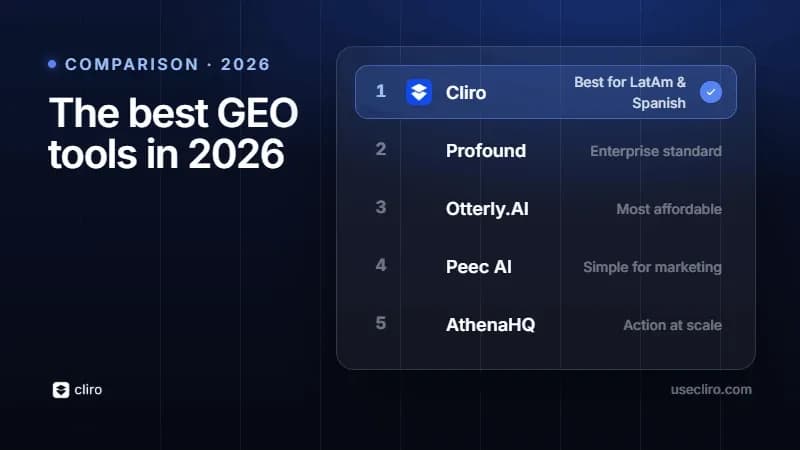
The best GEO tools in 2026
We compare the best GEO tools in 2026 —Cliro, Profound, Otterly, Peec AI and AthenaHQ— and which type of team each one is for.
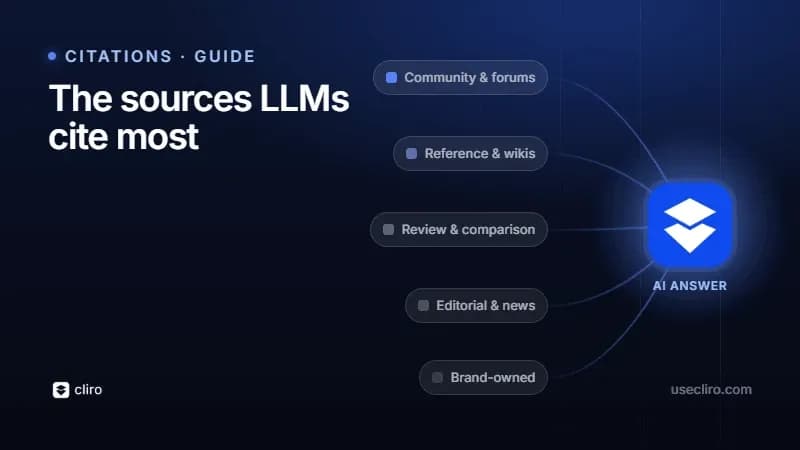
What kinds of sources do LLMs cite most?
What kinds of sources ChatGPT, Gemini and Perplexity cite most, according to the studies: why Reddit, Wikipedia and YouTube dominate, and what to do about it.