
How to appear in Perplexity
Perplexity cites only a few sources per answer. How to make your brand one of them: crawlability, extractable content, freshness and authority.


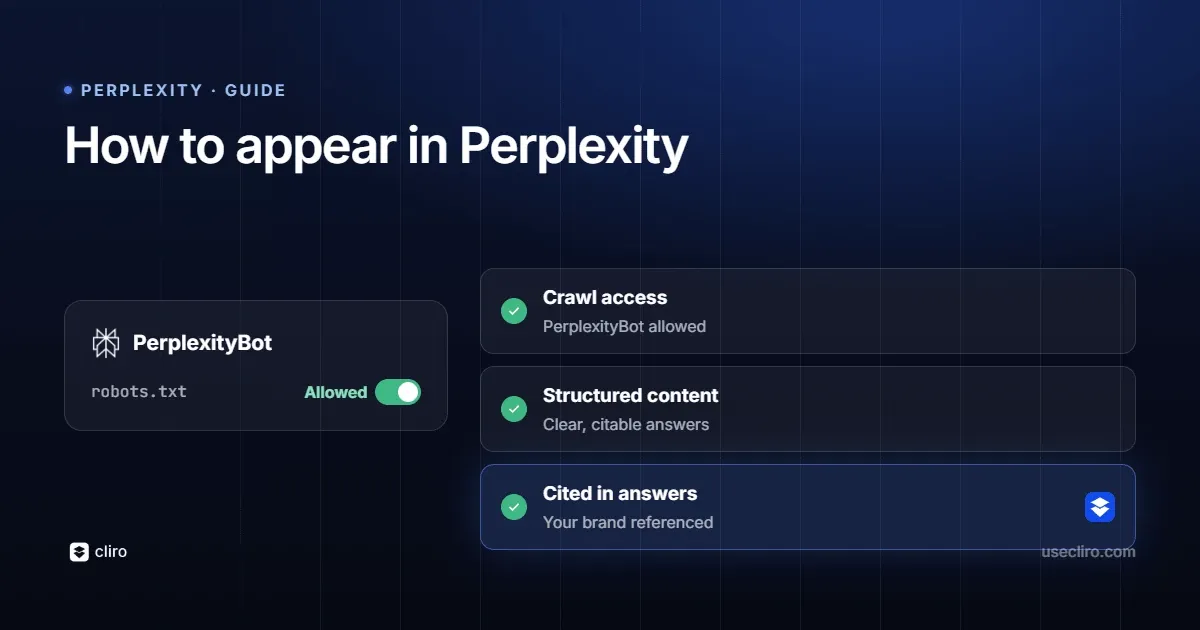
Perplexity is different from ChatGPT and Google: it's an answer engine that searches the web in real time and shows its sources right there, with little numbers. That makes it, paradoxically, the most measurable and the most "winnable" of them all: if you understand how it picks sources, you can get into them.
To appear in Perplexity you have to be one of the few sources it cites in its answer. That depends on two things: that it can crawl and read your page (access), and that your content is clear, extractable and trustworthy (absorption). Add freshness, original data and brand authority, and you'll appear more often. And because Perplexity shows its citations, it's also the easiest engine to measure.
How Perplexity differs
While ChatGPT mixes training and search, and Google relies on its index, Perplexity lives on live web search and transparently shows the cited sources, usually only three to five per answer. Its objective isn't to optimize clicks but helpfulness and factuality. That's why being cited matters more than any "position".
The two gates: access and absorption
Appearing in Perplexity means passing two filters. First, it has to select you as a source when searching: it needs to be able to crawl and read your page. Second, your content has to be absorbed into the answer: it has to be clear and citable. Fail either one and you don't appear.
How to appear in Perplexity, step by step
1. Make your site crawlable and fast
This is the prerequisite: if Perplexity can't access your content, there's no citation. Make sure your pages are crawlable, the content is in the HTML, and they load fast, because slow pages get skipped.
2. Answer first, in an extractable way
Put the answer in the first lines and structure it in clear blocks. Perplexity "absorbs" fragments: the easier it is to take a clean answer from your page, the better your chance of being cited. This is AEO.
3. Cover the whole topic
From definition to process, examples, caveats and next steps. Completeness and entity coverage help Perplexity use you to explain the topic accurately.
4. Add original data and clear authorship
Generic content doesn't get cited; first-party data, frameworks and observations do. And show who's writing (authorship, an "about" page): anonymous content rarely gets cited.
5. Keep it fresh
Perplexity prefers current information. Outdated pages are risky to cite, so update data and dates regularly.
6. Build authority and cross-presence
Perplexity favors authoritative domains and cross-references several sources. Being cited elsewhere —including Wikipedia, Reddit and forums in your niche— increases the chance it picks you.
7. Measure (it's the easiest engine to measure)
Because it shows citations, you can track the "perplexity.ai" referrer in your analytics and test your key prompts. An AI visibility platform like Cliro does this systematically and at scale. If you don't know where to start, see how to know if your brand appears in AI.
Common mistakes
- Slow or non-crawlable pages: you don't pass the first gate.
- Generic content with nothing citable.
- Burying the answer far from the start.
- Anonymous content with no visible authorship.
- Not updating: freshness matters.
This guide completes the per-engine series
If you want to cover the big three, see also how to appear in ChatGPT and in Google AI Overviews and Gemini.
Frequently asked questions
How do I "rank" in Perplexity?
It's not a fixed position: it's being cited often as a source for queries in your topic.
Does SEO help?
The crawl and authority foundation helps, but add AEO (extractable content) and freshness.
Why does it cite Wikipedia and Reddit?
They're high-trust sources it cross-references often; being well represented there, genuinely, helps.
Is it the easiest engine to measure?
Yes, because it shows the cited sources: you can track the "perplexity.ai" referrer and monitor your prompts.
How many sources does it cite?
Usually few (three to five per answer), so the competition to get in is real.

Written by
Federico Ergang
Cliro cofounder & CEO
Federico Ergang is cofounder and CEO of Cliro, the AI visibility and GEO platform for Latin America.
Related articles

How to appear in ChatGPT: an optimization guide (GEO)
A practical GEO guide to getting ChatGPT to mention and cite your brand: how to give it access, structure your content and be in the sources it consults.

How to appear in Google AI Overviews and Gemini
How to get your brand to show up in Google's AI Overviews and Gemini: why SEO is the foundation, the role of Google-Extended and what content wins.

What kinds of sources do LLMs cite most?
What kinds of sources ChatGPT, Gemini and Perplexity cite most, according to the studies: why Reddit, Wikipedia and YouTube dominate, and what to do about it.